
Estancia Police Chief Tom Carter Lays Out Vision for Torrance County Sheriff's Race
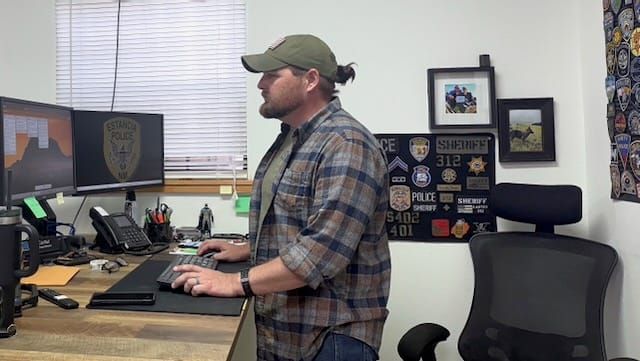
Candidate cites training failures, jurisdictional overreach, and proactive policing as central themes of his campaign
Note: All individuals referenced in connection with criminal investigations or arrests are presumed innocent unless convicted.
Estancia Police (EPD) Chief Tom Carter sat down with The Mountainair Dispatch on April 25, 2026, for an extended interview covering his candidacy for Torrance County Sheriff, his record leading the Estancia Police Department, and his assessment of the current state of law enforcement in the county. Carter, who has served as EPD chief for approximately two years, spoke candidly about the operations, philosophy, and priorities he would bring to the sheriff's office - as well as his criticisms of incumbent Sheriff David Frazee.
Why He Is Running
Carter said the decision to run for sheriff grew from a combination of genuine concern for the county and frustration at the limits of his current jurisdiction.
"I've reached the limits of what I can do in this jurisdiction," Carter said. "I'm seeing all this stuff that's happening out in the county - whether it's leadership or manpower or training or whatever it is - it's not getting addressed, and that's affecting me here in Estancia."
Carter was direct that seeking the role of Torrance County Sheriff is not a career stepping stone. "I'm not checking a box," he said. "I just want to do good law enforcement."
He also cited Sheriff Frazee's conduct during the COVID-19 pandemic as a formative grievance. Carter expressed particular frustration over the March 22, 2023 arrest of Christina Estrada at the Moriarty Magistrate Court over a mask mandate - an arrest Carter views as an example of constitutional overreach. He said it was a factor that "pushed me over the edge to run."
"I do believe that there was some overreach there," Carter said, referring to the pandemic-era arrests. "I'm still upset about that."
Carter's position is that a sheriff confronted with a court order to enforce a mask mandate should have declined to make arrests rather than comply with what he considers a constitutionally questionable directive.
His Assessment of the Torrance County Sheriff's Office
Carter's criticism of the sheriff's office centers less on individual cases and more on what he characterizes as failures in leadership and training culture.
"I've seen incidents where I believe maybe arrests should have been made, or more police work should have been done, and it wasn't because of culture, or [a belief that it is] okay to be lazy," Carter said. "The culture there is not like pursuing excellence and doing the best we can for our people. It's 'what can I get away with?'"
Carter was careful to distinguish between the deputies themselves and the environment in which they work. "I don't want this to sound like the deputies that are there are bad people," he said. "I think they're a product of their environment. The leader is responsible for all of that."
He cited the Extreme Ownership philosophy - associated with retired Navy SEALs Jocko Willink and Leif Babin - as a framework he takes seriously, even when it is uncomfortable to apply.
As one illustration of the training gaps he perceives, Carter described a recent conversation with a sheriff's office deputy who lacked a working understanding of the Safe Pursuit Act, New Mexico's law governing when officers may initiate vehicle pursuits.
"He didn't understand it, and it's nothing against him personally," Carter said. "That's the administration's responsibility."
Carter said he worked with the deputy to improve the deputy's understanding of the law.
Carter also pointed to a pattern he finds telling: he said 23 deputies left the sheriff's office during Frazee's first 22 months in office, with roughly 95 percent departing without adverse findings - meaning they left voluntarily, not under disciplinary clouds.
"The caliber of people that they were speaks volumes to what was happening in the sheriff's office at that time," he said, praising the departing deputies, some of whom now work in EPD.
Carter also noted that the district attorney's office has taken an unusually direct role in training sheriff's office deputies on report writing and case preparation, a development he described as unprecedented in his career and as indicative of systemic problems with how cases are being built for prosecution.
"The DA's office is literally trying to have a direct influence on how those cases are prepared," Carter said. "That speaks to something."
The MOU Dispute and the Question of Jurisdictional Authority
One of the more substantive legal questions Carter raised involves the memorandum of understanding between Estancia and Mountainair Police Departments, providing for cross-jurisdictional support. Frazee claimed the MOU violated New Mexico law, and sent a memorandum to Estancia Mayor Runnel Riley in which he threatened to arrest Carter for impersonating a police officer. Frazee also claimed, in a March 23, 2026, interview, that the sheriff's office holds some form of authority over municipal police departments.
Carter rejected that framing flatly. "We have the same authority," he said. "He just has a bigger jurisdiction than we do. That's it."
Carter said Frazee has never personally reached out to him with concerns about EPD's operations, despite Frazee's public statements to the contrary. "I've never spoken to him, other than 'Hey, Sheriff, how are you,'" Carter said, adding that in any professional or legal context, outreach of that kind would leave a paper trail - emails, letters, logs - which Frazee has not produced.
Carter also noted that Frazee does not hold a state law enforcement certification, which is not legally required for an elected sheriff but has practical implications. "He's not required to, because he's an elected official," Carter acknowledged - while also noting that Frazee has shown up armed at active scenes, a practice Carter described as concerning, given the lack of certification and formal law enforcement training.
Child Predator Operations: EPD's Proactive Sting Program
One of the most detailed sections of the interview concerned EPD's undercover child predator operations - a program Carter said he initiated because the county has a high rate of sex crimes and because he was frustrated that state biennial training funds flow readily to DWI enforcement but not to child protection work.
Carter said EPD officers entered online platforms and posed as minors, a tactic he described as legally demanding because of entrapment standards that require suspects to initiate sexual conversations organically rather than being solicited.
"I respect the entrapment issue," Carter said. "Even the bad guys have constitutional rights. I would say especially the bad guys have rights."
To learn the tradecraft involved, Carter sent two EPD officers to El Paso to train with a unit that regularly conducts this type of investigation. EPD also joined the Internet Crimes Against Children Task Force, a state and federally supported network, though Carter said the task force was primarily reactive - routing cases to member agencies - rather than providing active operational support.
Carter said that the EPD program produced three arrests within approximately six weeks, generating additional investigations when phones and devices seized from suspects were found to contain child sexual abuse material, known as CSAM. Carter said several cases are still active and moving toward prosecution, with at least one having resulted in a guilty plea.
Carter noted a secondary effect he views as a success even without additional arrests: word spread among potential offenders that Estancia was actively monitoring for this activity, and approaches dropped off.
"If I can get criminals to say, 'We're not going to go to Estancia,' I feel like I won," he said.
Carter expressed concern that rural communities are targeted disproportionately by predators who assume law enforcement there is less organized and less proactive. He also urged parents to take a more active role in monitoring their children's online activity, specifically naming gaming platforms and device chat features as vectors he has seen exploited in local cases.
"Parents definitely have to take an active role," Carter said. "I don't think people are willing to take the time to look into Roblox and the PlayStation chats and social media." Los Angeles County has sued Roblox for failing to protect against child predators using the open-world game for targeting.
Carter added that his own son's online activity is closely monitored and that, in his view, a strong parent-child relationship is the most effective deterrent against online predators.
Narcotics Enforcement: Proactive Over Reactive
Carter described EPD's approach to drug enforcement as deliberately proactive, using informants, buy-bust operations, and investigative pressure to identify dealers before they operate, rather than simply responding to incidents.
He said the department has seen tangible results: drug dealers who operate in surrounding communities have declined to bring their activity into Estancia, telling EPD informants they will meet elsewhere but not in town.
"We were doing buy-busts and stuff, and we've noticed that people will say, 'Yeah, I'm willing to sell drugs to you, but not in Estancia,'" Carter said.
Carter's view is that drug trafficking in Estancia originates primarily from outside the town limits, a geographical reality that limits what EPD alone can address and that makes the sheriff's race directly relevant to his law enforcement goals.
"I can't stop it here because I'm just chasing that low-hanging fruit here," he said. "We've got to affect that on a regional level. This entire region needs to be addressed with those types of crimes, and it's not happening now."
He also emphasized the partnership between EPD and the district attorney's office, which he described as deeply integrated into EPD's case preparation, with deputies maintaining direct phone contact with prosecutors and seeking real-time guidance on which evidence is needed to sustain charges.
Mental Health and the Limits of Policing
Carter spoke at length about a gap he experiences regularly: calls that are essentially mental health crises being handled by officers who have tactical training but not clinical tools.
"People call the police on that," Carter said, describing calls involving individuals in psychiatric distress. "We go up and we're like, 'Hey, do you want to hurt yourself? Are you in control of your own thoughts?' And they answer all the questions, they check the boxes. What am I supposed to take him to jail for?"
Carter acknowledged the frustration families experience when officers do not remove a disruptive or concerning person, but said officers are legally constrained in what they can do without probable cause for an arrest.
He expressed broader concern about the erosion of mental health infrastructure.
"There are no resources," Carter said.
He stopped short of proposing a specific policy solution, but expressed openness to co-responder models and expressed frustration with the expectation that law enforcement will substitute for mental health services that do not exist.
Surveillance Technology: A Skeptic on Flock Cameras
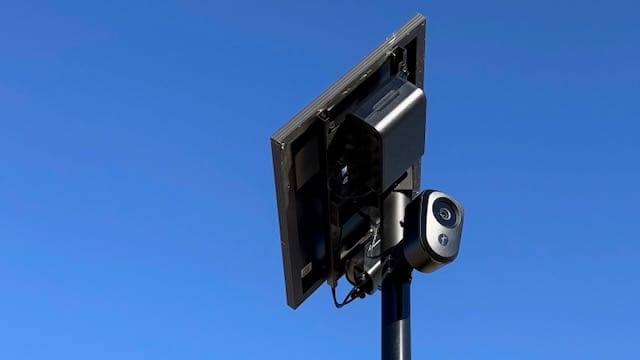
Carter said he has "mixed feelings" about the Flock Safety license plate reader cameras currently deployed by the Torrance County Sheriff's Office, east of Mountainair and north of Estancia, and indicated that if elected sheriff, he would be inclined to shut them down pending a review.
"If I took office tomorrow, we're going to turn those off and look at it," he said.
His concern is not primarily with how his own officers would use the data, but with who else has access to it and under what circumstances. He cited the potential for misuse - including by private parties who might subpoena camera records to track an individual's movements - as a reason for caution.
"Somebody could get all of the Flock camera information and get their ex-wife's traveling behavior," Carter said. "Is the government helping, or are we hurting with this tactic?"
Carter acknowledged that the technology has legitimate public safety applications. Carter cited as an example the use of Flock or another automated license plate reader (ALPR) to track an abduction suspect toward the interstate when there are not enough patrol units to cover the highway manually. But he said those benefits do not resolve his unease about data access and third-party use.
Carter referenced the plain view doctrine - the legal principle that officers may observe and act on what is visible in public space without a warrant - but noted that the doctrine was developed before technologies capable of recording, storing, and analyzing the movements of an entire population existed. He said that the gap in the law is unresolved and makes him uncomfortable with its current deployment.
Traffic Enforcement: A Deliberate Skeptic
Carter described himself as a persistent skeptic of traffic enforcement as a departmental priority.
"I think it's overused," he said. "I think it's chicken shit for the most part. To pull somebody over and write them a ticket for a window tint, a seatbelt, or a license plate light - all that's doing is justifying our existence as law enforcement. Who's the victim?"
He said EPD's own data from his two years as chief does not support the premise that traffic stops improve road safety. EPD recorded approximately six vehicle crashes during that period, Carter said, four of which occurred on private property, with the remaining two attributable to weather and distraction rather than speeding.
"I can't make a data-driven decision that traffic enforcement - meaning writing tickets for traffic violations - equals safer roads," he said.
He added that he believes agencies that rely heavily on ticket metrics often mask a lack of productive investigative work. "Everybody hates us," is the predictable result, he said, when traffic enforcement becomes an agency's primary public-facing activity.
Leadership and Training Philosophy
Carter returned repeatedly throughout the interview to his philosophy of leadership - one he described as individualized, emotionally demanding, and grounded in the premise that the quality of line-level police work rises and falls with the quality of supervision and training above it.
"Confidence equals less force," Carter said, summarizing what he views as a direct relationship between officer training and officer-involved use-of-force incidents. "As you increase somebody's skill set and their comfort, you get less emotion in an incident, which means less likelihood of making a mistake."
He described his approach as treating each deputy as a distinct individual with a different background, different learning style, and different relationship to authority - and adapting his leadership accordingly. He acknowledged this approach is "incredibly exhausting" but views it as the only one that produces genuine results.
Carter also said he plans to invest aggressively in deputy training if elected, including training in digital forensics, specialized investigative techniques, and areas in which deputies are personally motivated to develop.
"Let's support people and cultivate their careers and their interests," Carter said, "because there's always a return for the agency."
He described the role of sheriff using a corporate analogy: "If you think about the CEO of a business, they support and train and equip the people that provide the service to the customers. In law enforcement, those people are the deputies. The services are law enforcement. Our customers are the citizens."
Background and Personal Context
Carter has served as Estancia police chief for approximately two years. He was previously a deputy with the Torrance County Sheriff's Office and has been involved in three officer-involved shootings during his career. He and his wife, who is a licensed therapist, reside in the Estancia area.
What Carter Says He Would Do Differently
Synthesized from across the interview, Carter's stated priorities as sheriff would include:
- Increasing deputy training investment, including in digital forensics, case preparation, and use-of-force law;
- Expanding proactive narcotics enforcement on a regional scale, beyond individual municipal boundaries;
- Continuing and expanding child predator operations, arguing that every agency - not just specialty units - should be equipped to address those crimes;
- Suspending the Flock camera program pending a review of data access and retention policies;
- Improving coordination between the sheriff's office and municipal police departments, which he characterized as currently marked by tension and a mistaken assertion of hierarchical authority on the part of the current sheriff; and,
- Reducing reliance on traffic enforcement as a primary activity metric in favor of investigative outcomes.