
Like Spinning Plates: The Torrance County Commission's Response to Transparency Complaints Validates Public Concerns
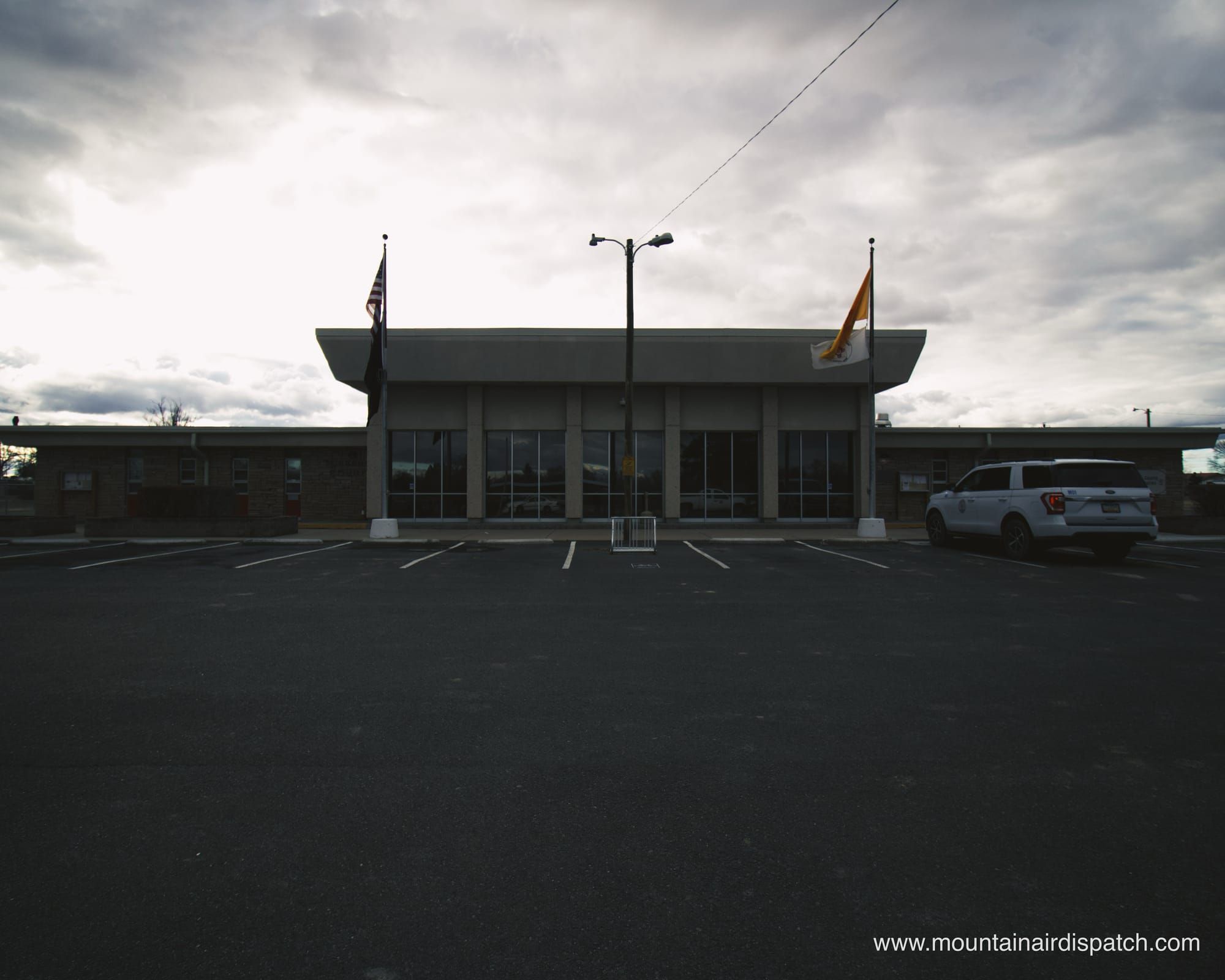
Recently, beginning at the July 22, 2026, meeting of the Torrance County Commissioners, residents have voiced complaints about the lack of transparency and candor they experience when dealing with the Torrance County government. Commissioners have responded to those complaints with frustration more often than transparency — including, at the commission's August 26, 2026, meeting, Commissioner Ryan Schwebach's on-the-record complaint that criticism of the commission amounts to lies, slander, and name-calling.
The commissioners themselves have suffered from the lack of transparency that members of the public have complained about. At the July 22, 2026, meeting of the Torrance County Commissioners, Commissioner Linda Jaramillo was caught off guard learning that Commissioner Kevin McCall had signed a non-disclosure agreement regarding county government negotiations over a commercial development proposal referred to as Project Mars — and that Commissioner Ryan Schwebach had also been kept in the loop while she had been excluded.
The Mountainair Dispatch sent Commissioners Linda Jaramillo, Kevin McCall, and Ryan Schwebach a formal request for comment on July 22, 2026, following that day's county commission meeting, asking where they stood on three matters where transparency appeared lacking: the New Mexico Attorney General's lawsuit against the county over its ICE agreement, the county's use of the Flock Safety automated license-plate reader (ALPR) system, and conditions inside the Torrance County Detention Facility (TCDF). The request also noted a multi-year pattern of unanswered inquiries on other subjects and set a deadline of July 31, 2026.
One commissioner responded with a same-day phone call and a candid conversation.
One submitted a last-minute written reply containing materially false statements.
One "ghosted" the Mountainair Dispatch entirely.
The July 22 Meeting: How Jaramillo Learned She Was Left Out of the Loop
The transparency complaints that opened this piece did not begin as an abstraction. They began in public comment at the July 22, 2026, meeting, over a preliminary economic development proposal the state has code-named "Project Mars," and they produced, on the record, a sitting commissioner learning in real time that her two colleagues knew things about county business development that they had intentionally kept from her.
Nine residents spoke during public comment, and the subject dominated the meeting before the commission ever responded. Kyle Metzger, whose family ranches land east of town, said he feared losing it to the project and criticized "these top secret closed door meetings." Onesimo Romero, a Torrance County business owner, told Commissioners Kevin McCall and Ryan Schwebach directly that they appeared to be checking their phones rather than listening to the public. Donna Romero, who lives near the JP Helms rodeo arena at the other end of Torrance County in Mountainair, asked commissioners why there had been no transparency and cited reported utility bill increases for residents living near data centers in Texas and Virginia. Dr. James Stevens, a member of the county's own Planning and Zoning Board, who identified himself as a credentialed chemist, raised a concern no official ever addressed on the record: whether the project might involve testing of propellants or explosives, given what he had heard described as "ballistic" work. Stevens's ballistics concern was never confirmed or denied by any commissioner or the county attorney in this meeting.
Commissioner Schwebach opened the commission's response by telling the room that "Project Mars is not a [data center]." Schwebach said that no information had been shared publicly because the project was too preliminary, and that the handful of residents who had called or emailed him directly had already been told what he knew.
Commissioner Jaramillo interrupted Schwebach, appearing shocked. "Excuse me for just one minute," she said. "When were you approached with this? Because I wasn't."
Schwebach's answer revealed the divide directly: "I was not approached for this. The way it was approached was the manager was approached, and Mr. McCall was a commissioner that it was sent [to]... my information that I was made aware of was very minimal until I had to ask the questions to find out more information... And like Linda said, she [County Commissioner Linda Jaramillo] was not approached for that because then it would be a quorum and it would be public information."
McCall, who described himself as "the commissioner that was in the lead" on the project, offered a legal rationale for keeping Jaramillo out of it: New Mexico's Open Meetings Act is triggered when a quorum of a public body deliberates or discusses public business outside a noticed meeting — not simply when multiple members happen to possess the same information. The state Attorney General's own compliance guide extends that rule to conversations spread across time, not just members sitting in a room together: "If three members of a five member board discuss public business in a series of telephone or email conversations, the discussion is a meeting of a quorum." For a three-member body like the Torrance County Commission, a quorum is two, meaning two commissioners conferring with each other about the same live matter, such as Project Mars, even serially, risks becoming an unnoticed public meeting. See Office of the New Mexico Attorney General, Open Meetings Act Compliance Guide (8th Ed., 2015) (PDF). Staff briefings for individual commissioners do not carry that risk, since staff are not board members.
But by the commission's own account, both McCall and Schwebach knew about Project Mars before Jaramillo did — McCall through two briefing meetings and a signed non-disclosure agreement, Schwebach through what he described as "very minimal" information he obtained only "because I had to ask what has transpired." That is already two of three commissioners aware of the same county business, which is the exact condition the quorum rule exists to police — not a loophole around it. The explanation only holds together if McCall and Schwebach were each briefed separately by county staff and never discussed Project Mars with each other directly outside the public meeting. Neither commissioner said that on the record, and neither was asked directly whether the two of them talked about it privately before July 22, 2026.
County Attorney Michael Garcia, who said he attended the same briefings, told the audience at the county commission meeting that the project "categorically was not a data center. Period," and that the land under consideration is state trust land rather than private property.
Jaramillo was not satisfied. "So when this came about, I was told that it was top secret," she said. "I wasn't privy to any other information about this... I don't like top secret. I don't like not being open with the public... I know it's not an AI center, but that's all I know as a commissioner so far."
McCall told her the county manager was supposed to be the channel for relaying information between commissioners.
Jaramillo's response went beyond Project Mars, to describe her working relationship with her two colleagues in general. "I haven't had any conversations with [Commissioners McCall and Schwebach] since I took office. The only time I talked to Commissioner McCall and Ryan [Schwebach] is in a meeting. There was never any conversations outside these meetings, and that's a year and a half."
Not every resident who spoke that day was persuaded by the commission's explanation. Kim Ortiz, who said she ranched on leased state trust land in a July 9, 2026, interview with the Mountainair Dispatch, and said she was approached by County Manager Stephanie Reynolds regarding a deal to get the Ortiz family off that land, pressed Schwebach and Garcia on whether the county had already begun taking preliminary steps — signing agreements, starting zoning work — before disclosing the project publicly.
Both denied it directly, with Schwebach stating flatly, "There has [sic] not been executive meetings." Ortiz was unconvinced, telling commissioners that nationally, "data centers" are often introduced to communities through non-disclosure agreements and later revealed to be exactly what officials denied.
Whatever the merits of the quorum explanation, it does not appear to have resolved the underlying frustration. At the commission's August 26, 2026 meeting, Torrance County resident Caleb Ortiz (son of Kim Ortiz) told commissioners he had filed a public records request on July 14, 2026, and, more than six weeks later, had received nothing — well past the 15-calendar-day production window state law normally allows. No commissioner or staff member addressed the timeline during that meeting. At the same meeting, Ortiz and a second speaker, Ernest Ortiz (Kim Ortiz’s husband), again raised "Project Mars" critically in public comment.
A pattern going back three years
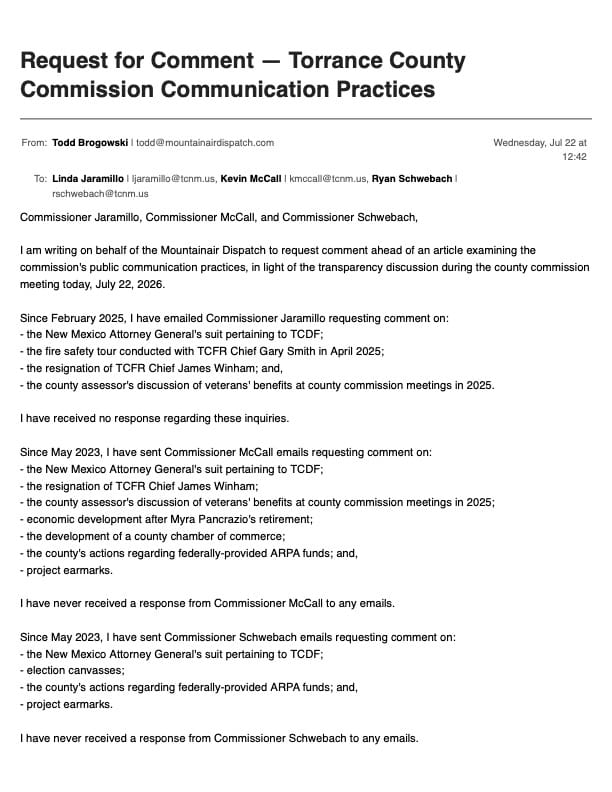
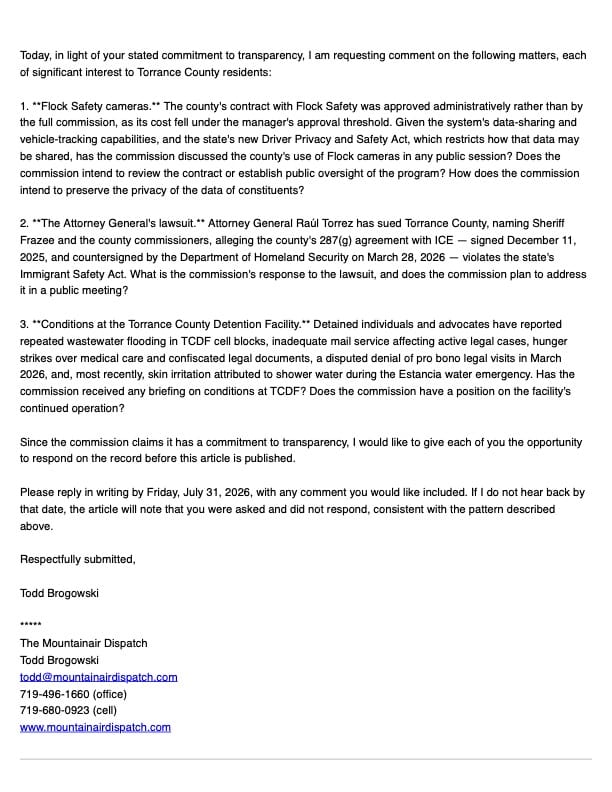
The July 22 email from the Mountainair Dispatch to the Torrance County Commissioners laid out that pattern in detail. Since February 2025, Jaramillo had not responded to Dispatch emails asking about the Attorney General's TCDF-related suit, an April 2025 fire safety tour with Torrance County Fire and Rescue (TCFR) Chief Gary Smith, the circumstances surrounding the resignation of former TCFR Chief James Winham, and a 2025 county commission discussion of veterans' property tax benefits.
McCall's non-response record stretches back further and covers more ground. Since May 2023, the Dispatch has asked him, without a single reply, for comment about topics including the aforementioned detention facility lawsuit, Winham's resignation, comments from the county assessor regarding veterans' tax benefits, economic development after Myra Pancrazio's retirement (from the Estancia Valley Economic Development Association), the prospect of a county chamber of commerce, the county's handling of federal ARPA funds, and legislative project earmarks.
Schwebach had not responded in writing to Dispatch emails on the detention facility lawsuit, election canvasses, ARPA funds, or project earmarks over the same period.
McCall: Radio Silence
McCall did not respond to the July 22 email, extending a written non-response streak that, on the record available to the Dispatch, has now run more than three years across at least seven distinct subjects.
Schwebach: "The best thing you do is call me"
Schwebach called the Mountainair Dispatch that same afternoon, after the commission meeting, and agreed to speak on the record. Asked directly why he had not responded to email inquiries, Schwebach said the fault was a mix-up, saying he mistakenly thought the emails were spam. He said he does not check email regularly and asked the Mountainair Dispatch - and the public - to reach him by phone or text going forward.
On the Flock Safety cameras, Schwebach confirmed the commission approved the system after a public discussion, and said he was "somewhat reluctant" to support it. His reasoning centered on US-60's role as a corridor for reported human trafficking. "What I do weigh is the amount of human trafficking that goes through here," Schwebach said, "And I do think about the lives that could be altered if we could simply grab a damn car in the 30 minutes that they drive through our county. That was my driving factor."
Commissioner Schwebach volunteered his own discomfort with the technology unprompted, saying, "I don't like Big Brother, looking at it, I don't like that concept," Schwebach said.
Schwebach acknowledged specific ALPR misuse cases raised in the conversation — law enforcement officers using similar systems to stalk women or to commit acts of domestic violence — as a real concern the commission had discussed. Asked whether there was a way to verify that access controls were actually in place, Schwebach said the commission had discussed the need for "very strict policy" on how the data is used, managed, and stored, but conceded he had not personally confirmed any of it had been implemented. "I personally have not followed up to see if any of those have been done. I couldn't tell you. I think that's a sheriff question," Schwebach said.
On the New Mexico Attorney General's lawsuit, Schwebach distinguished between two separate legal disputes. The first, an Open Meetings Act dispute stemming from a December 30, 2024, commission meeting to extend the county's ICE contract, drew a letter from the New Mexico Department of Justice the following month questioning whether proper notice had been given. Innovation Law Lab, an immigrant-advocacy legal organization active on Torrance County detention issues, separately criticized the county's handling of the notice. The county adopted a revised Open Meetings Act compliance policy in response, and the matter did not proceed to litigation, Schwebach explained. Schwebach called it "a political grandstand" that the county resolved by fixing its notice procedure.
On the current lawsuit — the Attorney General's May 27, 2026, suit over the 287(g) agreement between ICE and the Torrance County Sheriff’s Office regarding the TCDF — Schwebach said he was limited in what he could say because the matter is in active litigation. He said the commission met in executive session and, in his account, decided to use outside counsel to defend Sheriff David Frazee.
On TCDF conditions, Schwebach said the county no longer reviews the facility's restricted-housing reports (restricted housing is a term used in the prison industry in lieu of the more charged phrases "solitary confinement" or "segregated housing"), a review he said ICE took over: "I have it in my head, ICE removed. They did not have to have the county review that."
Schwebach described his own inspections, announced and unannounced, as consistently finding the facility "clean" and "well ran, well maintained," and said most of the specific allegations raised in public comment that he looked into personally turned out to be "overexaggerated or non-existent." He also acknowledged the facility has had non-catastrophic water and food issues at times, distinct from the town of Estancia's separate water-supply emergency.
Schwebach reflected on the state of law-abiding immigrants and asylum seekers in the detention facility. "Are there immigrants or asylum seekers that got caught up in it? Absolutely. I wish it wasn't that way, but it was." Schwebach thought for a moment, then corrected himself. "It is."
Jaramillo: written, at the deadline, with a claim that does not hold up
Jaramillo replied in writing at 2:15 AM MDT on July 31, 2026, with a lengthy, personal response. On the New Mexico Attorney General's lawsuit, she declined to comment, citing pending litigation. On the 2025 fire department tour, she said it was not a formal "safety tour" but a drive to familiarize the incoming fire chief with the district. On Winham's resignation, she called turnover a normal part of county government. On comments by the county assessor regarding veterans' tax benefits, instead of addressing the veterans' tax benefits, she wrote about her late husband's service-connected disability claim and her uncles' service in World War II.
On the detention facility, Jaramillo wrote: "You did not ask me about the detention center even though I have been in the detention center on four different occasions to see the conditions for myself." She went on to describe her tours of TCDF, including visits to medical, booking, and housing areas, and her appearance in a Bloomberg News documentary about the facility.
The statement is ambiguous on its face — it could mean that the Mountainair Dispatch did not ask about the detention center in the July 22 email itself, or that the Mountainair Dispatch had never previously raised the subject of prison visits with her at all. Neither reading holds up against the record.
If Commissioner Jaramillo meant the July 22 email, question three of that email — quoted in full beneath her reply, in the same message thread — asked directly: "Has the commission received any briefing on conditions at TCDF? Does the commission have a position on the facility's continued operation?" The question she said was never asked appears in the very email she was answering.
If she meant the Mountainair Dispatch had never previously raised the subject, an earlier, separate exchange contradicts that too. In March and April 2025, the Mountainair Dispatch emailed Jaramillo asking to accompany her on a TCDF visit, as it had previously done with then-Commissioner Samuel Schropp. Jaramillo replied the same day that she preferred to go in alone at first, "to get familiar with staff and the detainees." Two weeks later, she emailed again to say she had completed her own tour of the facility and would report back to the commission. That exchange directly records the two discussing prison visits, contradicting Jaramillo’s claim.
Jaramillo closed her July 31 reply by writing that she answered "with an openness that I am known for" and apologized "for the times that I didn't," attributing early gaps to being new to the position, after 18 years as Torrance County Clerk and eight years as deputy clerk before her election to the commission.
Why it matters beyond one exchange
The three questions the Mountainair Dispatch put to the commission on July 22 are not abstract. The Attorney General's suit, filed May 27, 2026, seeks to force Torrance County to terminate the 287(g) agreement that Sheriff Frazee signed with US Immigration and Customs Enforcement (ICE) on December 11, 2025, and the US Department of Homeland Security (DHS) countersigned on March 28, 2026. The New Mexico Attorney General's office alleges the agreement violates the Immigrant Safety Act, which took effect May 20, 2026, and argues the agreement diverts sheriff's deputies from local law enforcement duties while exposing the county to civil rights liability (New Mexico Department of Justice press release). The Dispatch first reported on the suit in May, when Sheriff Frazee and the county did not respond to a request for comment either.

The Flock Safety camera system was approved administratively rather than by a recorded vote of the full commission, because its cost fell under the county manager's approval threshold. New Mexico's Driver Privacy and Safety Act, which took effect July 1, 2026, now restricts how license-plate data collected by systems like Flock may be shared (ACLU of New Mexico). Schwebach's account confirms the commission discussed the need for a strict data-access policy before approving the system, but also that, by his own admission, nobody on the commission has since confirmed that policy is actually in place. Since Schwebach's interview, three New Mexico law enforcement agencies — Taos, Bernalillo County, and Grants — have cut ties with Flock Safety (KRQE). Nationally, the company's technology has also turned up at the center of criminal cases against officers misusing it (KSL), and in lawsuits alleging its network shares driver data with federal immigration authorities far beyond what any single agency agreed to (Courthouse News Service).
Torrance County has not, as of this writing, announced any review of its own Flock contract.
With respect to transparency issues and TCDF, detained individuals and advocates have reported wastewater flooding in TCDF cell blocks, inadequate mail service affecting active legal cases, hunger strikes over medical care and confiscated legal documents, a disputed denial of pro bono legal visits in March 2026, and skin irritation attributed to shower water during the Estancia water emergency. Those are allegations, not established findings, and Schwebach disputes the more serious of them based on his own inspections. But the county's own account confirms that formal county review of the facility's restricted-housing conditions, at the least, has lapsed since ICE assumed that oversight role.
How It Ends
The Mountainair Dispatch's July 22 request-for-comment email cited "the transparency discussion during the county commission meeting today" as the news hook for this piece. A month later, it was clear the transparency discussion did not end on July 22. At the commission's August 26, 2026, meeting, after facing residents' questions and frustrations about water, the county's PILT (payment in lieu of taxes) funding, and the detention facility's role in the county budget, Commissioner Schwebach said, "I appreciate you guys coming out. I appreciate your input. I don't appreciate the slander and name-calling. It's uncalled for. It's lies, and nothing more."