
New Mexico Attorney General Sues Torrance County, Sheriff Frazee Over ICE Agreement
State alleges the county's 287(g) memorandum of agreement with Immigration and Customs Enforcement violates the Immigrant Safety Act; ICE has yet to provide required training to any Sheriff's Office personnel
New Mexico Attorney General Raúl Torrez filed suit against Torrance County and Torrance County Sheriff David Frazee on Wednesday, May 27, 2026, demanding a court order requiring the county to terminate its memorandum of agreement (MOA) with Immigration and Customs Enforcement (ICE) under the federal 287(g) program. The lawsuit, filed in the Seventh Judicial District Court in Estancia, alleges the county is in direct violation of the Immigrant Safety Act, the state law that took effect one week before the complaint was filed.
The complaint names two defendants: the Torrance County Board of County Commissioners, as the governing and legislative authority of the county, and Sheriff David Frazee in his official capacity. A parallel lawsuit was filed the same day against Curry County and its sheriff in the Ninth Judicial District Court.
"Local officials take an oath to uphold the law, all of it, not just the parts they agree with," Attorney General Torrez said in a press release issued Wednesday. "No county sheriff has the authority to nullify a statute simply because he disagrees with it. That is not how our constitutional system works, and this office will not allow it to stand."
What the Immigrant Safety Act Requires
New Mexico Governor Michelle Lujan Grisham signed House Bill 9, the Immigrant Safety Act (ISA), into law on February 5, 2026. The law, codified at Sections 13-9-1 through 13-9-6 of the New Mexico Statutes Annotated, took effect on May 20, 2026. The Mountainair Dispatch covered the bill's introduction in the Legislature in March 2025.
The ISA prohibits "public bodies" — a category the law defines to include county governments, sheriff's departments, and any entity receiving public funding — from entering into 287(g) agreements with ICE. It also requires public bodies to terminate any existing 287(g) agreements at the earliest date permitted under the agreement's terms. Section 287(g) of the Immigration and Nationality Act authorizes the federal government to enter into written agreements with state and local law enforcement agencies, delegating to designated and trained local officers the authority to perform certain immigration enforcement functions, including the investigation, apprehension, and detention of noncitizens. See 8 U.S.C. § 1357(g) (2024).
Separately, the law bars public bodies from using real property for federal civil immigration detention and from deputizing personnel to perform the functions of federal immigration officers.
The law does not prohibit local law enforcement from detaining individuals or conducting brief investigative stops permitted under New Mexico law. It specifically targets cooperation with ICE.

Torrance County's 287(g) Agreement
The 287(g) program, authorized under Section 287(g) of the Immigration and Nationality Act, allows ICE to enter into written agreements with state and local law enforcement agencies, delegating certain immigration enforcement authority to designated local personnel. Participation is voluntary under federal law, and agreements may only be carried out, in the language of the statute, "to the extent consistent with State and local law."
Sheriff Frazee signed a 287(g) MOA with ICE on December 11, 2025. DHS Assistant Director Russell Hott countersigned the agreement on March 28, 2026. The agreement is classified as a warrant service officer (WSO) agreement, which authorizes local law enforcement personnel to perform immigration arrests within jails and correctional facilities.
Under the terms of the MOA, designated Torrance County Sheriff's deputies would be authorized to serve and execute immigration arrest warrants and warrants of removal on individuals held in county jail and correctional facilities at the time of their scheduled release from criminal custody, for the purpose of transferring those individuals to ICE. The agreement allows the county to hold such individuals for up to 48 additional hours beyond the time they would otherwise be released under state law.
The complaint states that either party may cancel the MOA with 90 days' notice.
A Wrinkle: ICE Has Not Provided the Required Training
A significant legal complication sits at the center of the case. Federal law requires ICE to train and certify local law enforcement personnel before they may perform any functions under a 287(g) agreement. The relevant statute, 8 U.S.C. § 1357(g)(2), makes training a necessary condition for local officers to perform federal immigration enforcement functions.
According to the complaint, ICE has not yet provided any of that training or certification to any Torrance County Sheriff's Office personnel. The Santa Fe New Mexican reported Wednesday that Frazee confirmed this himself earlier this month.
The Attorney General's complaint argues that without training and certification, Torrance County Sheriff's deputies currently have no legal authority — under either federal law or the MOA's own terms — to perform the immigration enforcement functions the agreement describes. Any deputies who attempted to do so, the complaint states, would be "acting ultra vires and exposing Torrance County to serious and immediate liability."
What the Attorney General Is Asking For
The complaint sets out two causes of action. The first alleges a direct violation of the ISA: the county is party to a 287(g) agreement that the state law requires it to terminate. The second alleges that Frazee and the county are acting beyond the authority granted to them by state law. The complaint notes that New Mexico law does not recognize any civil or criminal offenses for violating federal immigration statutes and does not authorize local law enforcement to arrest or prolong the detention of an individual solely for a suspected civil immigration violation.
The complaint also raises a due process issue regarding the immigration warrants contemplated by the MOA. Unlike criminal warrants, administrative immigration arrest and removal warrants are issued by executive officials within DHS, not by a neutral magistrate, and do not require a probable cause finding that any crime has been committed. New Mexico courts have found that prolonging a person's detention solely for suspected federal immigration violations constitutes a new seizure under the New Mexico Constitution.
The Attorney General is asking the Seventh Judicial District Court to:
- Declare that the ISA requires the defendants to immediately terminate the 287(g) MOA and prohibits them from entering into any new 287(g) agreement with ICE.
- Declare that the defendants may not arrest or detain any individual solely for suspected civil violations of federal immigration law or based solely on an administrative immigration arrest warrant or warrant of removal, absent a judicial warrant or court order.
- Preliminarily and permanently enjoin the defendants from exercising, enforcing, or modifying the 287(g) MOA other than to terminate it.
Torrance County’s Stated Position
Sheriff Frazee told the Santa Fe New Mexican earlier this month that he had no plans to back out of the ICE agreement despite the new state law. The Mountainair Dispatch requested comment regarding the Attorney General lawsuit from Sheriff Frazee, County Commissioner Ryan Schwebach, County Commissioner Kevin McCall, County Commissioner Linda Jaramillo, and County Manager Jordan Barela on Wednesday, May 27, 2026 regarding the lawsuit. They did not respond.
Relationship to the Torrance County Detention Facility
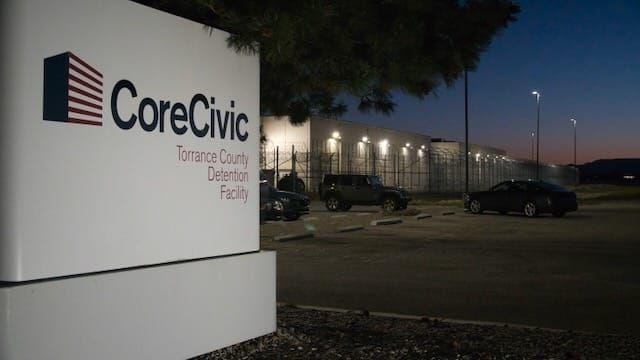
The 287(g) MOA at issue in Wednesday's lawsuit is distinct from the intergovernmental service agreement between Torrance County, ICE, and CoreCivic for the operation of the Torrance County Detention Facility (TCDF) in Estancia. The TCDF agreement covers ICE's use of the detention facility for civil immigration detention and is a separate legal instrument. The Torrance County Commission most recently voted to extend the CoreCivic contract in April 2024.
The Mountainair Dispatch will continue to cover this lawsuit as it proceeds.