
Residents Push for Answers on Wind and Transmission Projects; County's Advisor Fields Both, Despite Saying He Represents Neither
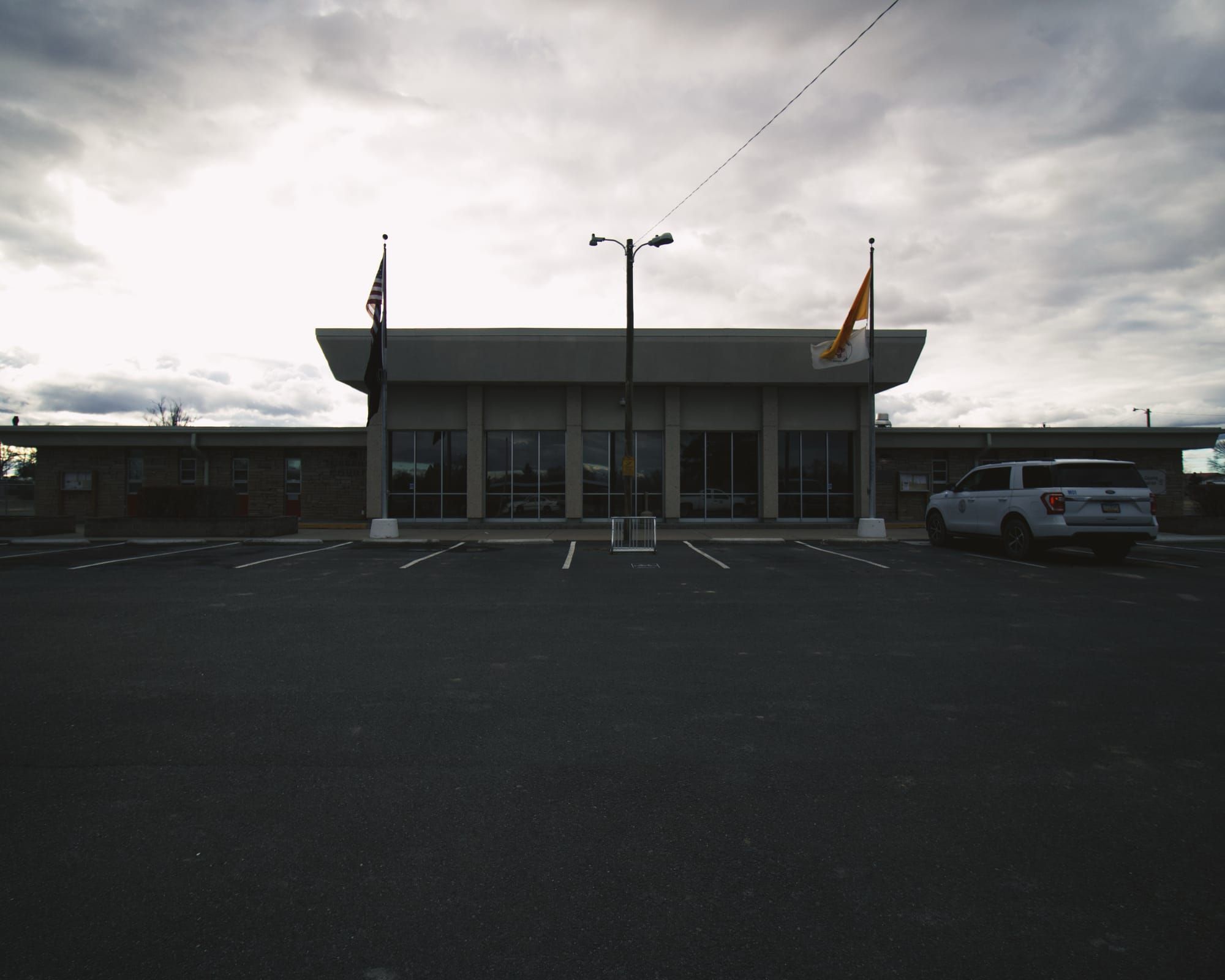
Torrance County’s financial advisor, Rob Burpo, disclaimed formal ties to PNM’s transmission project, then fielded engineering, water and environmental questions about it anyway, while the county attorney, Michael Garcia, defended commissioners against accusations of self-dealing.
ESTANCIA, N.M. — Art Tapia drove from Moriarty on Wednesday, August 26, 2026, after hearing, late the night before, that the Torrance County Board of County Commissioners would take up an item connected to PNM’s proposed Mid-State Transmission line. He was not alone. A dozen or more residents, several from the Loma Parda area west-southwest of Mountainair, showed up prepared to speak against a 345-kilovolt line some fear will cross their land.
What they got instead was an apology, a procedural delay, and roughly ninety minutes with a financial advisor who told them, more than once, that the power line was not his subject.
“I think maybe the simplest thing, Mr. Burpo here — he’s one of the representatives regarding this project,” Commission Chair Ryan Schwebach told Tapia early in the meeting, before Rob Burpo’s presentation had even started. It was an answer that, as the morning went on, turned out not to hold up.
A hearing that was not properly a hearing
Before public comment began, Schwebach told the room that agenda item 8e — a bond ordinance financing Pattern Energy’s Palomas Power wind turbine project — “had not been advertised correctly,” meaning that the county had not followed state law regarding notice requirements. New Mexico law requires that kind of bond ordinance go through a formal public hearing before the commission can vote, and the county’s notice for Wednesday’s meeting did not do that.
“Because it wasn’t published appropriately on the agenda, we’re not going to take action on that today, but we will [hold a public hearing at the next meeting],” Schwebach said. He invited anyone present to speak anyway, with their comments sworn in and entered into the record for that future hearing, which is now scheduled for the board’s September 9, 2026 meeting.
Several residents did exactly that. Don Grate, who said he lives in the Loma Parda area, which Grate described as a “viper’s nest” without elaborating as to his meaning. Grate was sworn in and told commissioners: “The current proposed PNM 345 kV line is going to potentially almost go right over my house, so obviously I’m against this. A large portion of all of the Loma Parda residents are against this, and we’ll fight this.”
Audra Tapia, appearing by Zoom, said landowners were never asked their opinion before the project moved forward: “If we do not want this on our property, if we do not want this around us, we should have an opinion and be able to voice that.” County Attorney Mike Garcia, who swore in each speaker, told them their testimony would carry into the record for the eventual hearing.
Two projects, one grid
Item 8e is a proposed bond ordinance authorizing up to $1,221,075,000 in taxable industrial revenue bonds for Palomas Power LLC, a Pattern Energy wind farm project in the Vaughn, Corona, Estancia, Moriarty, and Mountainair school district areas. PNM’s Mid-State Transmission project — the roughly 100-mile, 345-kilovolt line running from near Lucy through Torrance County to Los Lunas that has organized Loma Parda-area opposition (see the Dispatch’s ongoing coverage of PNM) — is a separate proposal, moving through a different state process entirely.
The two are connected in one real sense: Palomas Power’s electricity is being sold to PNM under a power purchase agreement now pending before the New Mexico Public Regulation Commission, and the wind farm sits in the same regional buildout, anchored around the existing Western Spirit switchyard, that Mid-State would extend. That overlap is very likely why residents who came to oppose the transmission line appeared to believe the county’s bond item concerned it too. But procedurally, the two are governed by different statutes, different state agencies, and, on Wednesday, different people at the podium.
A financial advisor, not a power-line engineer
The presentation on item 8e came from Rob Burpo, president of First American Financial Advisors, Inc., an Albuquerque-based, SEC-registered investment advisory firm. Burpo has served as Torrance County’s contracted financial advisor since 2019 and told commissioners he has worked in municipal bond finance since the 1970s, structuring industrial revenue bond deals for New Mexico local governments, including the Intel Corporation expansion in Sandoval County and a Walmart distribution center financed by Valencia County. A New Mexico House record from the 2000 legislative session shows Burpo also sponsored the “Private Property Protection Act” as a state representative that session, matching what he told commissioners about his own legislative history.
He opened by heading off the confusion directly: “I don’t want to disappoint you, but I’m not here to talk about Project Mars. I’m not here to talk about a PNM power line. I’m only here to talk about the Palomas wind turbine project.”
“The line issue I have never been involved with,” Burpo told one questioner. “I do not represent Pattern in any way. They are on absolutely one hundred percent on the other side of the table from there. … I represent [the] County Commission and the citizens of Torrance County.” Asked directly whether he negotiates with landowners, he said no: “I never negotiate with any landowner. It’s prohibiting the conflict of interest.” Asked an engineering question about how power flows through PNM’s system, he said, “I’m not the engineer. … If it’s got a dollar sign, I’m pretty good, but when you get into engineering stuff, not so much.”
He also volunteered to help close the information gap he could not fill himself, telling commissioners he would contact PNM and Pattern Energy directly ahead of the September 9 meeting to bring back answers on water usage, the transmission line’s relationship to the wind project, and the county’s authority — or lack of it — over transmission siting through the Rural Electric Transmission Authority (RETA) and the PRC. “I will call PNM. I know the people down at PNM,” he said, adding: “They’re pretty guarded in what they tell you.”
Via email on Wednesday, August 26, 2026, Erin Brizuela of Burns & McDonnell, an engineering firm working as a contractor for PNM, confirmed Burpo did not have a business relationship with PNM or the other entities involved with the Mid-State Transmission Project.
Burpo spoke outside his stated scope and competency
Despite those disclaimers and his lack of an engineering background, Burpo did not simply decline the out-of-scope questions and move on. Over the course of an hour, he appeared to be eager to provide substantive answers on several of them anyway.
Burpo claimed that the Mid-State Transmission lines were not necessary under present circumstances. “It’s my understanding power line is not required, that it’s for future purposes,” Burpo said. Burpo offered no evidentiary basis for this claim.
On whether Pattern’s environmental review of the wind project was adequate, he told the commenter, “Pattern is required to do substantial environmental studies, and they’ve done that.”
No PNM or Pattern representative confirmed, corrected, or fielded those questions directly, although Brizuela wrote that several members of the PNM Mid-State Transmission project team, which includes representatives of both PNM and Pattern, were present at the meeting. The County Commissioners did not seek confirmation, correction, or other responses from Pattern or PNM at the meeting. Commissioners have scheduled both companies to appear at the September 9 hearing.
What the bond actually pays for
Under New Mexico’s County Industrial Revenue Bond Act, NMSA §§ 4-59-1 to -16, and its use of a related payment structure, the county formally “issues” the bond and holds a paper title to the wind project’s equipment, but Pattern Energy — not the county — is legally the borrower and is solely responsible for repayment. “Money does not ever flow out of the county on any of these industrial revenue bonds ever,” Burpo told commissioners. “It is statutorily prohibited.” Burpo said that, in exchange for lending its tax-exempt status to the project, the county and affected school districts receive a “payment in lieu of taxes,” or PILOT. Burpo does not appear to have a background in the law, based on his online presence. Torrance County’s attorney, Michael Garcia, did not offer legal analysis of the act or the arrangement with Pattern.
Burpo told the commission the Palomas Power PILOT would pay roughly $630,000 in its first year, stepping up five percent every five years, for an average of about $780,000 annually and a stated total of $21,426,000 over 30 years. Of that, he said, the county would keep about $13 million and the five affected school districts — Vaughn, Corona, Estancia, Moriarty, and Mountainair — would split roughly $8.4 million under a state-legislated formula based on turbine location, acreage, and enrollment. Burpo cited specific per-district and per-student figures during his presentation that did not consistently reconcile as delivered.
Statewide evidence contradicts Burpo’s assurances and is worth weighing against Burpo’s sales pitch. A July 2026 New Mexico Legislative Finance Committee policy review found that industrial revenue bonds have produced roughly $265 billion in issuances across about 210 projects statewide since 2000, at a cost of an estimated $2.7 billion in forgone local government revenue and $784 million in forgone school district property tax revenue — against which New Mexico school districts collected just $10.1 million in PILOT payments in fiscal year 2024-25. PILOT payments, the LFC noted, are legally required only for electric generation, transmission, and energy storage projects like Palomas Power, and remain optional and unevenly applied elsewhere.
Burpo also told commissioners that a decommissioning requirement — obligating Pattern to remove turbines and restore land within 18 months of the lease’s end, backed by a performance bond starting in the deal’s fifth year — has been standard in Torrance County wind deals only since 2019, after older turbine blades were left stacked along the road near Encino. “That’s kind of my deal,” he said of pushing for the requirement.
Commission attacks accusations of secrecy
Burpo’s presentation followed public comment in which two residents, Caleb Ortiz and Ernest Ortiz, accused commissioners of pursuing the Project Mars economic development effort without adequate public input and disclosures. Caleb Ortiz told commissioners he filed a records request on July 14 and had “received nothing over a month and a half later.” Project Mars is a proposed commercial development project, to speak vaguely due to lack of information, about which members of the county commission and the county manager have signed non-disclosure agreements, as previously reported.
Later in the meeting, after further audience questioning of the commission’s motives on the wind and transmission projects, County Attorney Michael Garcia shifted from an advisory role for the county to an advocate for the county commissioners themselves. “The people that I see sitting up at that table are some of the most conscientious, dedicated, selfless government people I have seen in my life,” Garcia said. “I have never seen a hint of self-dealing on their part, and any accusation, any moral accusations against them is [sic] wide of the mark.”
Burpo followed with his own praise of the commissioners. “I’ve represented fifteen different counties at one time or another over years, and I have never seen a group that is any better than these gentlemen here and this lady here.”
Schwebach closed the discussion by defending the commission’s record on transparency and acknowledging the limits of county authority over water and transmission siting. “I appreciate you guys coming out. I appreciate your input,” he said. “I don’t appreciate the slander and name calling. It’s uncalled for. It’s lies, and nothing more.”
Funding Matters
In other action Wednesday, commissioners voted unanimously to approve a memorandum of understanding with the New Mexico Secretary of State’s office for $59,049.69 in state funding to run the November general election, and to approve payables covering August 4 through August 19, 2026.
Commissioners also voted to pursue two simultaneous applications for a portion of $5 million in state capital outlay funding freshly reallocated from stalled projects statewide, one for the county’s administration building and one to complete an addition housing the New Mexico State University Cooperative Extension Service’s office space at the county fairgrounds. Grants Director Jody Cornwall said the fairgrounds addition is roughly 95 percent designed and could be finished within six months if funded.
The Fire/EMS department received approval to manage its seasonal, part-time firefighter staffing under a $40,000 annual budget cap rather than a fixed headcount limit, and Torrance County Professional Fire Fighters Local 5441 secured a memorandum of understanding extending compensatory time provisions already available to other county employees to firefighters, adjusted for their longer average work year.
Veterans Integration Center
Michelle Fraire of the New Mexico Veterans Integration Center presented on the organization’s transitional housing, financial assistance, and case management services for unhoused and at-risk veteran families in Torrance County, including outreach conducted directly at veterans’ homes. (Readers should be on the lookout for additional reporting on the Veterans Integration Center and what it can do for Torrance County veterans.)
Commissioners also heard from several other residents during public comment. Debbie Mayberry, Torrance County’s Cooperative Extension Service director, thanked the commission for the new fairgrounds building, crediting it with expanding 4-H and adult education programming countywide. A McIntosh resident, introduced in the meeting as Albert Beckwith, described a 40-minute delay in reaching him during a medical emergency because his rural road has no street signage, and asked the county to address the gap for the safety of other veterans and first responders.
What’s next
The properly noticed public hearing on the Palomas Power bond ordinance is scheduled for the board’s next regular meeting, September 9, 2026, at 9:00 AM MDT, at 205 S. Ninth Street in Estancia. Commissioners said Pattern Energy representatives are expected to attend and address questions on water usage and wildlife impact directly, and Burpo said he would report back on PNM’s and RETA’s position on the Mid-State transmission line’s relationship, if any, to the wind project.