
Torrance County plans zoning overhaul and rewrites economic development law amid transparency concerns
A proposed rewrite of the Torrance County zoning ordinance would cap backyard poultry flocks at 24 birds, bar the installation of mobile homes more than 30 years old, prohibit living in storage sheds, and tighten controls on cannabis grows. The Torrance County Board of County Commissioners voted 3-0 on Wednesday, October 14, 2026, to publish the draft ahead of a public hearing and possible adoption on Thursday, November 12, 2026.
At the same meeting, commissioners approved an amended economic development ordinance that removes the defunct Estancia Valley Economic Development Association (EVEDA) as the county's economic development agency. The vote followed a public hearing in which residents pressed the county attorney on whether commissioners can sign nondisclosure agreements (NDAs) with private economic development groups, a question that has followed the county since the Project Mars data center proposal collapsed earlier this year.
Commissioners also tabled a request from the Torrance County Assessor's Office to restructure job titles and raise pay. County Manager Stephanie Reynolds announced that county employees will move to the City of Albuquerque's health insurance plan in January.
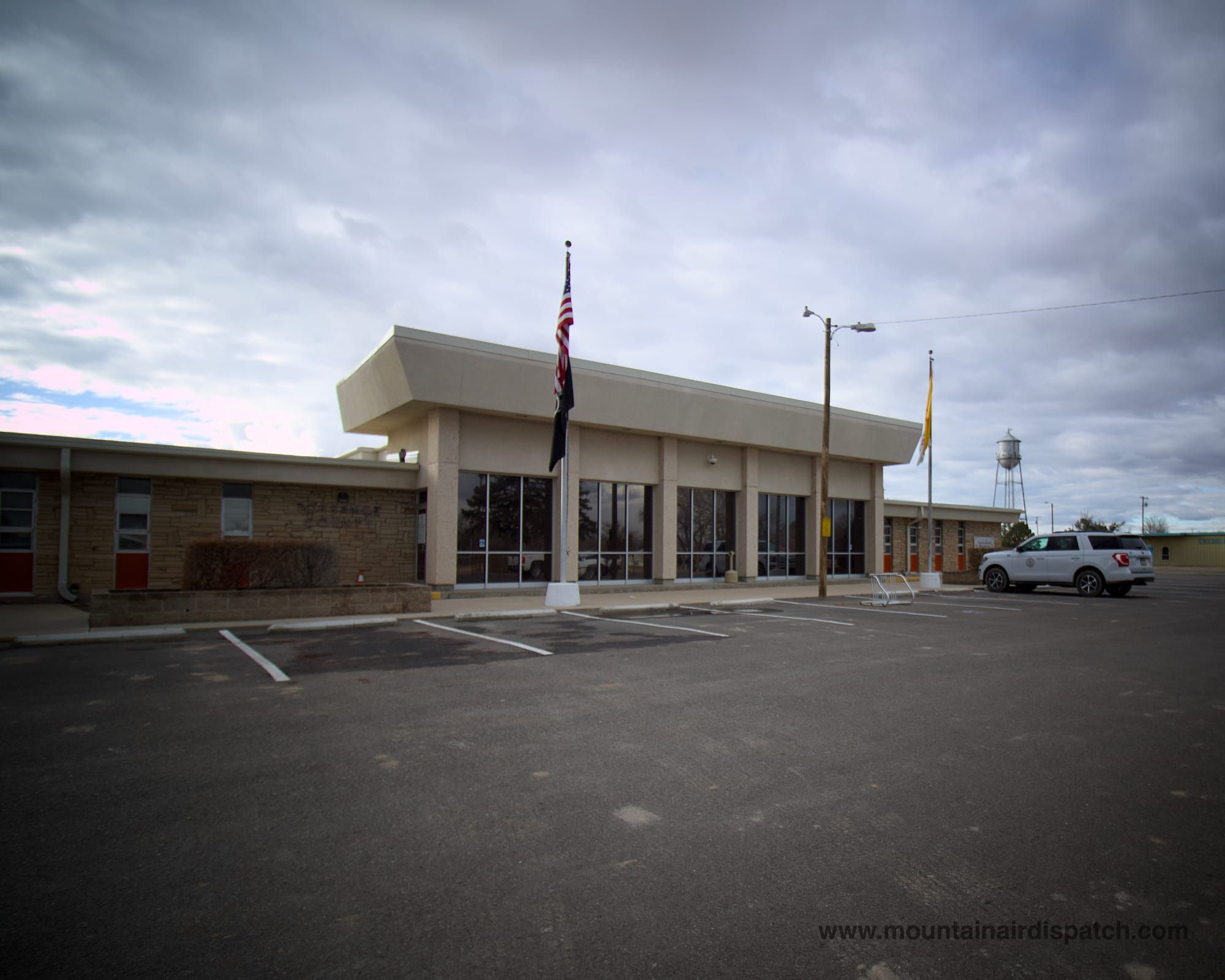
Chair Ryan Schwebach (District 2), Vice Chair Linda Jaramillo (District 3), and Commissioner Kevin McCall (District 1) attended the meeting at the Torrance County Administrative Offices, 205 South Ninth Street, in Estancia.

Zoning revision would limit poultry, older mobile homes, and cannabis grow size
Disclosure related to a potential conflict of interest: The author owns agriculturally zoned property in Torrance County and keeps poultry.
Planning and Zoning Director Don Goen called the proposal "a comprehensive revision" of the county zoning ordinance, which was first adopted in 1990 and last amended on November 13, 2024. Goen said much of it clarifies language, but several changes would directly affect what residents can keep, build, and live in on their property.

Under the draft, "no more than 24 poultry are allowed in any combination per household," and more than 24 "will constitute commercial activity and may require a Conditional Use permit." One turkey or goose would count as two chickens or ducks. The limit is written into the ordinance's definition of poultry and does not distinguish between residential and agricultural zones. The current ordinance defines poultry but sets no limit.
Goen said he first considered a cap of 12 before settling on 24. He described a case from several months ago in which, he said, a code enforcement officer found a property with about 150 roosters. Goen said the owner simply "loves roosters" and reduced his flock when told to.
Commissioner Jaramillo asked whether that resident would be grandfathered in.
"No, no, no. We're not going to allow that," Goen said. "Just because there wasn't something in there that says that you can't doesn't mean we're going to say you can."
Goen's answer is more complicated than it sounded. The existing ordinance, which the revision leaves in place, contains a grandfather clause for uses that were lawful before an amendment. The Mountainair Dispatch examines the legal issues raised by the proposed zoning amendments in a companion article, to be published shortly (this article will be updated to link to it; email subscribers, both free and paid, will automatically receive the article).
The draft would also replace the county's only age rule for used mobile homes. Since 1990, a used mobile home brought into the county has had to be built in 1977 or later to meet federal Department of Housing and Urban Development (HUD) standards. The revision would instead bar installation of any mobile home "older than 30 years." The cutoff would move forward each year. In 2026, it would be 1996, and in 2027 it would be 1997.
Goen said the 1977 rule allowed the county to become a destination for aging homes that Bernalillo and Sandoval counties no longer wanted. Goen did not provide figures at the meeting on how many such homes have been placed in the county.
"Basically, well, to just put it in flat language, that prevents us from receiving other people's garbage," Goen said.
He said buyers would still be able to find affordable used homes. When Jaramillo called it "a big change," Goen said that Doña Ana County only accepted homes built in 2002 or later when he last checked a few years ago.
Other changes Goen described include:
- Sheds. Living in a shed would be explicitly prohibited unless the Construction Industries Division (CID) approves plans to convert it or the shed is built to full residential standards. Violators could face a fine of up to $300, up to 90 days in jail, or both. Goen said living in sheds is already not allowed, but the county has had to cite other laws to stop it.
- Cannabis. Each parcel could hold only one state cannabis production or manufacturing license. Growers would have to disclose their plant count, and facility size would be tied to it, from 1,750 square feet for 500 mature plants up to 70,000 square feet for the state maximum of 20,000. Any change in plant count or building size would require Planning and Zoning Board approval. Goen said the county has about eight active cannabis operations and has not seen a new application in more than a year. He said the state Cannabis Control Division (CCD) had given the change "a thumbs up."
- Water storage for hauled water. A licensed contractor holding a GB-98 license from CID could design the on-site storage systems required when a property relies on hauled water. Previously, only a licensed engineer or architect could. Systems drawn by property owners would still need an engineer's or architect's stamp.
- Flood zones. Property owners building in a flood hazard area would have to submit a post-construction elevation certificate within one year, a change Goen said FEMA requested to keep the county in good standing with the National Flood Insurance Program (NFIP).
- Domestic wells. When the county reviews a proposed land use's effect on water, new individual domestic wells would no longer count as an "impairment of prior existing water uses."
- Livestock math. One horse or cow would equal five goats or sheep instead of three. Goen said the change matches US Department of Agriculture practice.
- Feedlots and kennels. The draft adds slope, setback, and stream buffer rules for feedlots, creates small, medium, and large feedlot categories, and defines residential, commercial, and foster or rescue kennels by animal count.
Goen said the county has used "zone" and "district" interchangeably for decades. The revision would make clear that zones, such as Rural Residential, are permanent land designations, while Special Use and Solid Waste districts sit inside a zone and revert to it if a project goes away. Rezoning a property requires action by the commission. Goen said many residents who ask for a rezoning actually need a conditional use permit.
Commissioner McCall asked whether commercial greenhouses growing tomatoes or nursery plants would face the new limits. Goen said the cannabis rules apply only to cannabis, though other commercial greenhouses still need a conditional use permit in some zones.
Goen said County Attorney Michael Garcia has reviewed the draft. He said he had already received questions from residents. The public meeting packet included the full 84-page draft and a 19-page reference sheet showing the changes in red.
A review of that reference sheet by the Mountainair Dispatch found changes Goen did not mention at the meeting. They include removing a rule that automatically approved certain adult land use applications if the commission failed to act within 60 days, eliminating the 10-day minimum notice before the commission can revoke a permit, lifting the ban on raising pigs in Agricultural Preservation zones, and limiting bed and breakfasts in several zones to eight guests.
Goen said the public hearing is set for November 12 because the commission's usual Wednesday meeting would fall on Veterans Day.
"I mean, instead of me handing you 84 pages saying figure it out, that's why I give this," Goen said of the reference sheet.
Economic development ordinance drops EVEDA
Following a public hearing in which resident Kim Ortiz questioned Garcia about nondisclosure agreements, commissioners voted 3-0 to approve Resolution 2026-37, adopting Economic Development Ordinance 2026-04. The ordinance amends Ordinance 2003-01, the county's plan under the state Local Economic Development Act (LEDA), which named EVEDA as the county's economic development agency. EVEDA no longer exists.
The amended ordinance lets the commission "assign an appropriate economic development agency" in EVEDA's place. That agency would review the cost-benefit analyses that businesses seeking county assistance must submit and would conduct annual performance reviews of assisted projects.
Commissioner McCall said the state Economic Development Department had told the county several times to update the ordinance because, as written, LEDA funds for the county flow through EVEDA. He said a potential client that wanted to reopen the greenhouses had expressed interest, and the state had LEDA money available as an incentive, but the county could not use it until the ordinance changed.
"This thing was passed back in 2003. Number one, number two, EVEDA is no longer in existence. We need to get this cleaned up," McCall said.
The Mountainair Dispatch reported on the dispute over the county's lack of a working economic development plan in its coverage of the September 23, 2026, commission meeting, published by the Mountainair Dispatch on October 1, 2026.
Residents press for answers on nondisclosure agreements
Kim Ortiz, who also spoke during general public comment, testified under oath at the hearing. She said she wanted to know whether a replacement agency would be subject to the Open Meetings Act and the Inspection of Public Records Act (IPRA), or whether it would be another privately controlled nonprofit "where secrecy and confidentiality is allowed."
Ortiz said she understood that elected officials were able to sign NDAs during Project Mars because EVEDA, as a regional nonprofit, was 51% privately funded. In general public comment earlier in the meeting, she pointed to Sandoval County's Project Ranger, a defense contractor's manufacturing and testing site financed with industrial revenue bonds (IRBs). She said residents there learned of it too late to change anything.
Garcia said he rejected "the premises" of her question.
"The reason for the NDA is not to keep things from the public; it's to make a negotiation successful," Garcia said. He compared it to confidential settlement talks in a lawsuit.
Asked by Jaramillo what law allows commissioners to sign NDAs, Garcia said the authority comes from state law. He said the state economic development agency is not subject to the same IPRA rules as counties and that companies often keep their identities private to keep land prices from rising. He said he believed IPRA contains an exception covering such information, but added, "I'll have to double-check for sure... I'm not sure about that, but I think that's the case."
IPRA exempts "trade secrets, attorney-client privileged information and long-range or strategic business plans of public hospitals," as well as records made confidential "as otherwise provided by law" (NMSA § 14-2-1(A) (2025)). The New Mexico Attorney General's IPRA compliance guide states that "merely declaring certain documents to be confidential by regulation or agreement will not exclude them from inspection," and that a public body cannot withhold a record simply because it received the record under a promise of confidentiality.
Garcia said the Open Meetings Act applies only when a quorum of commissioners is present and when action is being taken. The Open Meetings Act applies to any gathering of a quorum of a public body held to discuss public business, whether or not action is taken (NMSA § 10-15-1(B) (2013)). On the three-member commission, two commissioners constitute a quorum.
Garcia also said IPRA applies to agreements between the county and other entities, but not to agreements between the state and private companies. IPRA applies to state agencies, including the Economic Development Department, as well as to counties (NMSA § 14-2-6(G) (2023)). Records held by a state agency about its dealings with a private company are public records unless a specific exception applies.
When Ortiz said Commissioner McCall had not answered questions in her records requests about the NDA he signed, Garcia said IPRA requires the production of existing records, not answers to questions. McCall said he had no records to produce regarding Project Mars.
"I was told where to be, when to be at the meeting, and that's when I attended. I had nothing else in writing, nothing in black and white," McCall said.
Andy Chavez urged commissioners to look at efforts in other counties to bar commissioners from signing NDAs. Charlene Brown, speaking by Zoom, supported Jaramillo's idea of a citizen economic development committee. Brown said written comments someone had submitted on the ordinance were evidently not included in commissioners' packets, and asked how residents could submit comments.
"I think it's probably a little bit late for that because we're already getting ready to vote on it," Garcia said.
Schwebach said a contractor would handle public outreach and planning. The county budgeted $100,000 for an economic development contract this fiscal year, and Reynolds said the request for proposals is out for a second time, closing on November 5, 2026.
Schwebach also said the county is a member of the Albuquerque Regional Economic Alliance (AREA), and that AREA connected the county with the client behind Project Mars. "That's how that came to be," he said.
Schwebach and McCall both said the ordinance does not bypass planning and zoning, public hearings, or the Open Meetings Act. Garcia added that state land development may require little county involvement at all, and that the county was brought into Project Mars "to try to make it work with the residents and the county."
Assessor's pay request tabled
Chief Deputy Assessor Linda Gallegos asked commissioners to reorganize the assessor's office, retitle positions, and tie pay increases to appraisal certification levels. She said the total increase across all employees would be $18.67 an hour. She did not have an annual cost estimate, saying she was unsure how benefits would affect it.
Gallegos said she brought the request now because Schwebach and McCall leave the commission at the end of the year, and she will also be gone after December. She said her previous agenda requests had not been heard. She noted that the assessor's office produces the valuations behind the county's property tax revenue, citing a $35 million increase from last year.
"I'm going to start by saying I'm not prepared to pass this today," Schwebach said. He said pay restructuring usually happens during the budget process, that he needed the annual cost, and that it is common practice not to make major changes to an elected official's office during a transition.
McCall said the request should have been made in May or June for the fiscal year 2027 budget. He said it was not fair to the incoming assessor and the incoming commission majority to make the change now. Jaramillo said the new assessor should bring it forward in the next budget cycle.
Gallegos said the commission had approved mid-year certification raises for the road department. Schwebach said that restructuring was discussed for two years, came with a full budget analysis, and did not involve an elected official's office. Commissioners voted 3-0 to table the request, and Schwebach said he would meet with Gallegos.
Fire and EMS items: new grant, opioid money, Mountainair costs
Fire Chief Gary Smith asked commissioners to ratify an application for a state House Bill 255 public safety workforce grant, which he said state Rep. Stefani Lord, R-Sandia Park, brought to the department's attention. The two-year grant would pay 100% of new positions in the first year and 50% in the second, after which the county would have to pick up the cost. Smith said he wants to use it to hire captains who would run community paramedicine, fire marshal, and wildland programs while also responding to 911 calls, including assisting Mountainair's thinly staffed ambulance service.
Smith said one possible long-term funding source is the county's opioid settlement money. Reynolds said $1.107 million is in that account. Schwebach said the money is one-time and restricted. Smith said he is consulting an expert on whether it can pay for staff with a rehabilitation and mental health focus. Commissioners stressed that ratification does not commit the county to accepting the grant, and the vote was 3-0.
Commissioners also approved, each by 3-0 votes:
- Reverting a state grant for a fire department comprehensive plan, which Smith said would not tell the department anything it did not already know: "We know we need more staffing. We know we need more water."
- Paying $664.16 to TLC Uniforms and $2,393.39 to Airgas for purchases made last fiscal year following the May 20, 2026, incident in Mountainair, in which three people died and first responders were hospitalized. State Police later said fentanyl, methamphetamine, and para-fluorofentanyl, a fentanyl analog, were found at the residence. Smith said responders lost personal property worth up to $5,000 to $6,000 when their belongings were taken at the University of New Mexico hospital. The president of the Torrance County firefighters union said individual claims against UNM are still pending.
- Reimbursing Andrew Jelson $2,030 for an EMT-Intermediate course. Commissioners asked staff to develop a countywide training repayment policy so the county does not pay for certifications that employees take to other departments.
- Applying for a New Mexico EMS Bureau grant for another rescue unit, with the 25% match coming from fire protection funds. Reynolds said that account held $394,000. Smith said Rescue 16 logged about 64,000 miles in under a year.
- Adding the county emergency manager to the EMS medical direction agreement with the county's medical director. Emergency Management Department Manager Samantha O'Dell said the provision was accidentally left out when the contract was renewed.
Other business
On the consent agenda, commissioners approved a Special Use District for Pattern Energy's Palomas Wind project, south of Interstate 40 and primarily east of US 285. The Planning and Zoning Board approved it on September 2, 2026.
While reviewing payables, Jaramillo asked about an invoice from CoreCivic, which operates the Torrance County Detention Facility, even though the county's contract with the company has ended. Reynolds said the payments are federal funds passing through the county to CoreCivic and do not come from county money, and that a few more may follow. Schwebach said a $320,000 payment to the water utility Estancia Moriarty Willard and Torrance County Regional Water Association (EMWT) was capital outlay for the purchase of the Sunset Acres water system, with the county serving as fiscal agent. He said the transfer of the Melody Ranch water system to EMWT is still pending before the Public Regulation Commission (PRC) and that residents there are receiving tank water.
Commissioners also corrected a 20-cent discrepancy in a Transportation Project Fund resolution approved at the previous meeting and approved the Estancia Valley Youth and Family Council board roster.
Clerk: early voting strong, IPRA a legislative priority
County Clerk Sylvia Chavez said 187 voters had cast ballots in person at the administration building in the first five days of early voting. Her office had mailed 537 absentee ballots, and 23 had been returned. Six overseas voters had requested ballots. The alternate early voting site at the Moriarty Civic Center, 202 Broadway Avenue, opens Saturday, October 17, 2026, and will be open 10:00 AM to 6:00 PM Tuesday through Saturday.
Chavez said New Mexico Counties has set four legislative priorities: appropriations for detention reimbursement, 700 MHz radios, and the disabled veterans property tax exemption; government solvency; changes to IPRA; and recognizing EMS as an essential government service. She said Torrance County ranks among the top 10 of the state's 33 counties for IPRA requests and that requests have "become weaponized" to the point that the county created a full-time records position. She said the county's records employee received 33 requests over the recent long weekend. McCall said IPRA changes have been a legislative priority for counties for six years without getting a hearing.
Chavez also said a New Mexico Oil and Gas Association presentation showed $16.1 million in oil and gas revenue distributed in Torrance County in 2025, including $3 million for capital outlay and $12.6 million for schools.
Manager: employee health insurance to change in January
Reynolds said that starting in January, county employees will have access to the City of Albuquerque's employee benefits package, including medical, dental, vision, and life insurance. She said the county paid broker Gallagher $27,600 a year and will pay $4,700 under the new arrangement, and that employees should see lower premiums. She said no employee had told her they were satisfied with the current coverage.
Reynolds said the annual audit was starting that day. She said behavioral health advocate Jackie Muncie is asking interested residents to attend an existing meeting on Monday, October 26, 2026, at 9:00 AM at the Neil Mertz Judicial Complex north of Estancia (903 5th St, Estancia, NM 87016), rather than forming a new committee. The request for proposals for a domestic violence coordinator closes October 29, 2026. Reynolds said the county has one posted vacancy: assistant chief of training for the fire department.
In commissioner reports, Jaramillo said she met with residents in Loma Parda regarding the PNM Mid-State Transmission Project. She will miss the October 28 meeting. The Dispatch's resident's guide to PNM's Mid-State Transmission Project explains how that project is reviewed by the PRC.
Executive session
Commissioners went into closed session to discuss the county manager position; a land purchase agreement with William A. Larson; a proposed grazing lease on county property; and requests for proposals for county legal representation and a DWI coordinator. Under the Open Meetings Act, any final action on those matters must be taken in an open meeting (see NMSA § 10-15-1 (2013)).