
Sheriff Responds to Estancia-Mountainair MOU Controversy
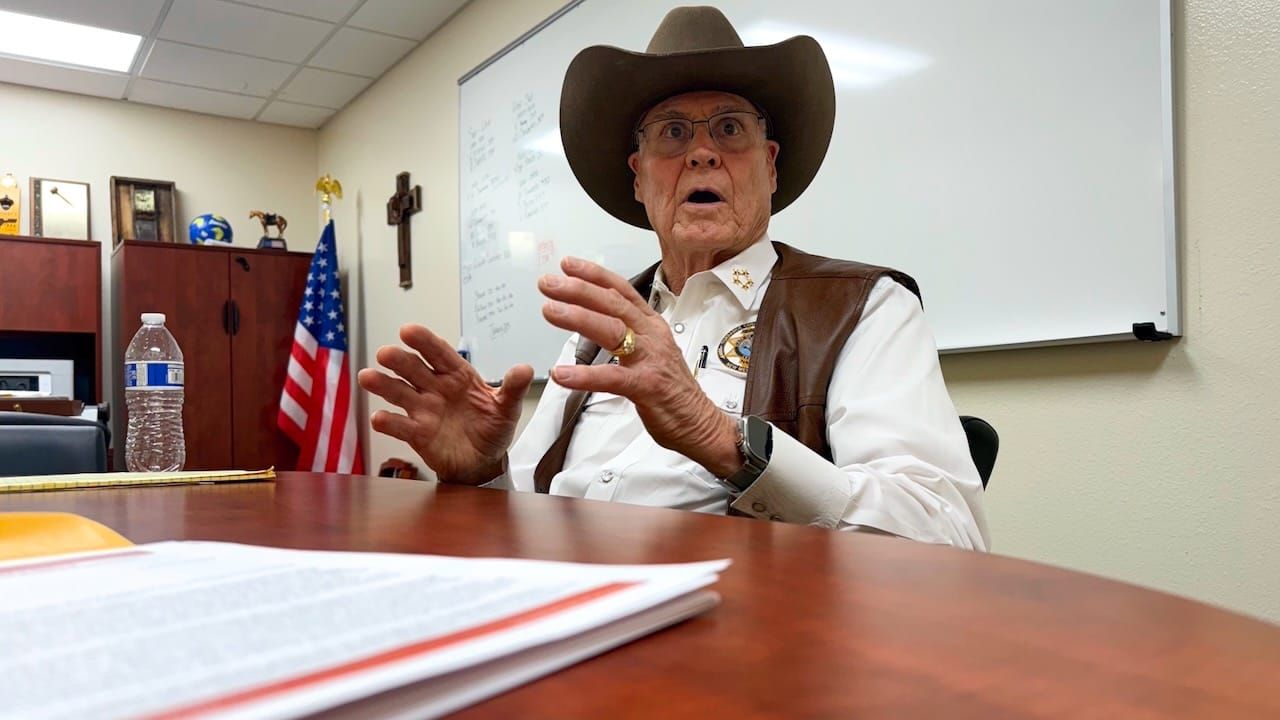
In an interview with the Mountainair Dispatch, Torrance County Sheriff David Frazee and Undersheriff Stephanie Reynolds lay out their timeline of the Estancia-Mountainair mutual aid dispute - and say liability, not politics, drove their actions.
Torrance County Sheriff David Frazee and Undersheriff Stephanie Reynolds sat down with The Mountainair Dispatch on March 23, 2026, at the Torrance County Sheriff's Office. The goal of the interview was to address the controversy surrounding a memorandum of understanding (MOU) between the towns of Estancia and Mountainair. This MOU has incited a public dispute between Frazee and Estancia Police Chief - and candidate for sheriff - Tom Carter.
To summarize the MOU dispute, Estancia and Mountainair drafted a memorandum of understanding in which both police departments agreed to offer each other assistance upon request. Sheriff Frazee expressed concern that he believed that the MOU did not meet the standards of the New Mexico Mutual Aid Act on December 18, 2026. Mountainair’s Town Council approved the MOU on January 20, 2026.
The dispute continued on February 20, 2026, when Sheriff Frazee wrote a letter to Estancia Mayor Runnel Riley, stating that Chief Carter and Estancia Police Sergeant (SGT) Jordan Duran, formerly of the Torrance County Sheriff’s Office (TCSO), had filmed TCSO Ron Saavedra conducting a traffic stop and commented that “Estancia Police Department doesn’t stop grandmas, but [that] they do ‘real’ police work.” Frazee also alleged that Estancia Police Department (EPD) had “taken it upon themselves to leave their legal jurisdiction and act as police officers where they have no legal right to, in violation of NMSA 1987 statute 29-8-3, by going into the town of Mountainair and effecting arrest authority when they lack jurisdiction, subjecting both Mountainair and Estancia to civil litigation.” (Emphasis in the original.) Carter responded on April 10, 2026 to Frazee’s allegations regarding the Saavedra traffic stop,
“We did not film anyone from TCSO. I would like to make a point that it is a well-known fact in New Mexico that law enforcement does not have any right to privacy while conducting a traffic stop on the side of the road, and anyone can legally photograph or film us. Not sure why Mr. Frazee indicated ‘without our consent’ in regard to that incident, because consent is not needed from whoever did the filming.”
-- Estancia Police Chief Tom Carter
In the same letter, Sheriff Frazee stated,
I have seen video of how the Estancia Police Officers handle their traffic stops and criminal investigations and they use overwhelming force. I do not believe the citizens of Torrance County need to be treated in this matter. I am very experienced in law enforcement, and this is NOT how we engage with the community. Someone is going to be hurt or killed with this type of law enforcement and that is exactly why I do not like [Estancia] police officers handling calls in my jurisdiction.”
-- Sheriff David Frazee, Letter to Estancia Mayor Runnel Riley (Feb. 20, 2026).
Carter indicated that Frazee was not seeing the difference between the appearance of force and the actual use of force. “We use the least amount of force required to take someone into custody. However, there are tactics that could be considered an overwhelming show of force.”
On March 6, 2026, Senior Public Safety Advisor to Governor Michelle Lujan Grisham, Benjamin Baker, emailed the governor’s approval of the MOU to Mountainair Mayor Peter Nieto.
On March 10, 2026, Sheriff Frazee saw the MOU was approved by the Governor’s Office. He sent an email to Mayor Nieto, Undersheriff Stephanie Reynolds, and the Mountainair Dispatch, “Thank you for providing this information to me. I believe any issues I had have been resolved. We will continue to support your town and in fact all cities, towns, and municipalities within Torrance County with law enforcement protection.”
Reasonable people could look at this story and conclude that it is much ado about nothing at this point. The memorandum of understanding at the center of the dispute has since received the governor's approval. No one was charged. No civil rights lawsuit materialized. But the dispute left something behind: a public conflict between two candidates for Torrance County sheriff, and a window into how thinly-staffed rural law enforcement agencies navigate the gaps in their coverage -- and who gets blamed when something goes wrong.
During his interview, Frazee stated that the MOU, which allowed Estancia police officers to operate in Mountainair's jurisdiction and vice versa, was not initially submitted to the governor’s office, as required by state statute. As a result, Frazee said, his office repeatedly urged municipal officials to correct the paperwork, beginning in December 2025. “First of all,” Sheriff Frazee explained, “The MOU they had going is null and void, being it's not signed by the government. There's case law on that. There's been lawsuits in other states about that.”
Frazee said he was concerned that the MOU, by not being approved by the governor’s office, created legal liability that could lead to loss of qualified immunity for officers and lawsuits against the municipal and county governments.
"If it is not done correctly and they are out there without legal authority, then basically they are impersonating a police officer because they do not have jurisdiction," Frazee said. "And if they make an arrest, that is false imprisonment."
Previous Dispatch coverage of the MOU dispute can be found here.
The Legal Issue: Whether the Governor's Written Approval is Required by Statute
At the center of the dispute is a New Mexico statute that requires memoranda of understanding between municipal law enforcement agencies to receive approval from the governor's office before they take effect. According to Frazee, an MOU signed only by participating municipalities — without that approval — is "null and void."
The statute, codified at NMSA § 29-8-3 (2024), states in full that "[any] state, county or municipal agency having and maintaining peace officers may enter into mutal aid agreements with any public agency as defined in the Mutual Aid Act, wiht respect to law enforcement, provided any such agreement shall be approved by the agency involved and the governor." Without wading too deeply into the legislative history of the law, this provision was first enacted in 1953 and has survived the two major reformations of New Mexico laws, which took place in 1971 and 2024.
"There is case law that shows where they are acting outside of the scope, and they should not be there," Frazee said, referencing court decisions from other states that have addressed similar arrangements.
Frazee said the distinction matters because, without proper authorization, officers operating outside their home jurisdiction lack legal authority. In his view, that exposes those officers — and the agencies involved — to serious legal consequences.
Sheriff Frazee was quick to clarify that his concern was never about stopping inter-agency cooperation.
”We understand they are short-staffed. We cannot always get out there in a hurry, because we are short-staffed. Other agencies going out there, I am all for it. Let them do it - the more they do, the less I have to send my guys out there. But I want it done correctly."
-- Sheriff David Frazee, March 23, 2026
The Timeline: December Through March
Frazee said his first outreach on the issue came on December 18, 2025, when he contacted Mountainair Mayor Peter Nieto to explain the statute and advise that the existing MOU needed to be submitted to the governor's office.
"I gave him the statute, explained what was going on, and told him that it is a violation," Frazee said.
He said he also spoke with Mountainair Police Chief Paul Lucero, Estancia Police Chief Tom Carter, and Estancia Mayor Runnel Riley on multiple occasions — both orally and in writing — urging them to correct the MOU.
"I had told them and told them and told them," Frazee said.
Undersheriff Reynolds said the sheriff's office also consulted with the county's legal counsel, who considered sending a cease-and-desist order to the municipalities.
"That was an option," Reynolds confirmed, adding that the county attorney advised the sheriff's office to maintain a paper trail documenting its efforts to address the issue.
Despite those repeated communications, Frazee said, the MOU was not corrected, and Estancia officers continued to operate in Mountainair without proper authorization.
The Incident That Escalated Concerns
Frazee described a specific incident that he believed crystallized the problem. Officers from the Estancia Police Department responded to Mountainair to serve a warrant on a woman Frazee described as a 90-pound individual with no history of violence. Six Estancia officers were involved.
At the time, Mountainair's chief of police was assisting a probation and parole officer on a separate arrest. When the chief learned that Estancia officers were operating in Mountainair — and that his presence was required under the MOU for it to be effective — he allegedly left the probation officer to respond to the Estancia officers' location.
"He leaves this guy by himself, runs over there, and we have to send backup to this guy making that arrest," Frazee said.
The result, Frazee said, was that the sheriff's office had to dispatch deputies to both Mountainair and Estancia to cover calls that the respective municipal departments could not handle, stretching already thin county resources.
"It does come back because we have to cover everything, so it falls back on us," Frazee said.
Liability: The Driving Concern
Both Frazee and Reynolds returned repeatedly to the question of liability as their primary motivation.
Reynolds, who said her years working in Santa Fe instilled a strong focus on legal exposure, pointed to the elimination of qualified immunity as a factor that raises the stakes for all law enforcement agencies in the state.
"If we are acting outside the scope of our policy and procedure, then we are not covered, [we are] personally liable for what happens," Reynolds said. "And that could result in civil rights violations."
Reynolds laid out a scenario in which she believed an improperly authorized operation could go wrong, the affected municipalities could face litigation, and the county — which knew the MOU was defective and failed to act — could be drawn into the lawsuit as well.
"The county knew that something was going on, and they did not act on it, so now we are going to go ahead and sue the county," Reynolds said, paraphrasing the potential legal argument. "That is what we were trying to get out of. We do not want any part of that."
Frazee said he researched what could happen to him personally if he knew about the situation and failed to intervene. The possibilities, he said, included removal from office, criminal charges, and civil liability.
"If I know about it and fail to act — yes, I am complicit," Frazee said.
He acknowledged that his letters to the municipalities did not explicitly mention the liability rationale, a point he conceded might have helped the public understand his position, in hindsight.
"Had I put that in there, it might have helped. I do not know," Frazee said.
"Nowhere Did I Say Stop"
Frazee pushed back firmly on the characterization that he sought to prevent Estancia from assisting Mountainair.
"There is nowhere, anywhere, that I said we want to stop you from going," Frazee said. "I think you all need help out there. I wish we had more deputies to send."
He said the message in every piece of correspondence was the same: get the governor's approval.
"In every correspondence, that is what was said," Frazee confirmed.
Reynolds echoed the point, saying the sheriff's office has no objection to inter-agency cooperation — provided it is done lawfully.
"They get that MOU signed properly and correctly, then, by all means, we are good with it," Reynolds said. "We have never said we are not okay with them going [to respond to calls].”
As noted above, in a February 20, 2026, letter to Mayor Runnel Riley, Sheriff Frazee stated he did not like Estancia Police Officers responding to calls in his jurisdiction.
Meeting With Estancia Council Members
Frazee said that before the issue became public, he met with two Estancia town council members, Albert Lovato and Martin Lucero, at the sheriff's office, where he presented the same documents and legal explanation he provided to the mayors and chiefs.
Frazee speculated that the council members may have reviewed the information and concluded the sheriff's position was sound.
"I think what might have happened is they went back, looked at it, and saw that it is a no story, and that it is a liability if they keep doing what they are doing, and they have decided maybe we better not do that," Frazee said.
No Discipline Sought for Estancia Chief
Asked whether anyone from the sheriff's office had sought disciplinary action or employee discipline against Estancia Chief of Police Tom Carter - a claim Carter raised at a recent Estancia town council meeting - Frazee said no.
"I have no say in that at all. That is totally up to their city council," Frazee said.
He added that the Estancia mayor signed the MOU, making it unclear why discipline would be sought through the sheriff's office.
The Election Factor
Frazee did not shy away from addressing the political dimension. Carter is a candidate for Torrance County sheriff, running against Frazee.
"I sense that they — whoever 'they' is [sic] — is trying to make this, because he is an opponent in running for sheriff, a political thing," Frazee said. "I am out to get them for whatever, so I look bad — to make me look bad, so that it makes them look good."
He acknowledged, however, that the public's frustration was understandable given that the letter surfaced without the months of prior communication that preceded it.
"All that came out was that last letter. So you saw nothing that led up to that," Frazee said. "And so I do not blame the people for getting upset. They look at that, they read that, and think, 'What the hell was this guy doing?' It makes sense."
County Coverage: "It Is Our Duty"
Frazee used the interview to underscore his office's commitment to providing law enforcement coverage across Torrance County, regardless of municipal boundaries and without charging municipalities for the service.
"I made a vow when I ran for office that I was not going to charge Estancia for sending police services over there. My predecessor did," Frazee said, referencing former Sheriff Martin Rivera's administration. "I just think that it is, personally, it is our duty to do it."
He said his office currently covers calls in Estancia, Moriarty, and Mountainair when municipal departments cannot respond, and that he has no intention of changing that practice.
Commissions vs. MOUs
The interview also touched on why the sheriff's office has not issued countywide commissions to municipal officers — a separate mechanism that would grant those officers broad law enforcement authority throughout the county.
Frazee said the liability concerns are even greater with commissions than with MOUs, because commissioned officers would effectively operate as deputies with county-wide authority but without county training or supervision.
"If we commission whoever, that gives them broad legal law enforcement authority in the whole county. They could then go out on their own, stop cars -- whatever they felt like doing," Frazee said. "And the liability involved in that is just through the roof."
Reynolds noted that the sheriff's office has been working on a formal policy governing how outside agencies operate in the county, but has not yet completed it.
"We were trying to come up with a clear, concise way that we could instruct the way that we call for help," Reynolds said. "We just have not completed that."
The DWI Incident and Trust Concerns
Reynolds also disclosed a separate incident involving the Estancia Police Department that she said contributed to the sheriff's office's decision to raise the MOU issue directly with the mayors rather than working through Estancia's chain of command.
According to Reynolds, an Estancia police officer responded to a call at a gas station regarding a highly intoxicated individual. The officer spoke with the man and cleared the call, reporting him as a tired driver. Minutes later, Reynolds said, the same individual was involved in a head-on collision with a mother and her daughter, both of whom required ambulance transport. Sheriff's deputies arrived and arrested the driver for DWI at twice the legal limit.
Frazee said he raised the matter with Estancia Chief of Police Tom Carter.
"He said, 'I reviewed it. I did not see that the officer did anything wrong.' End of story," Frazee recounted.
Reynolds said that response eroded the sheriff's office's confidence that the MOU issue would be addressed at the department level.
"We did not trust that it would be addressed at his level," Reynolds said. "So we went to the mayors."
What Happens Next
With the MOU now bearing the governor's approval, the legal dispute appears resolved, or at least moot. Frazee said that when Mayor Nieto informed him the approval had been secured, his response was simple.
“I said, 'Fine. We are happy with that,’” Frazee said.
However, Frazee noted that despite having the approved MOU in hand, Estancia officers have not resumed operations in Mountainair.
"They have got the governor's signature, but for some reason, they have not gone back over there," Frazee said.
Frazee said the TCSO remains committed to inter-agency cooperation and to covering calls across the county.
"We are not bashing anybody," Frazee said. "We are trying to do our job and keep us from getting sued, and keep them from getting sued, and hopefully keep people from getting hurt."