
Torrance County Commissioners Hear Abuse Allegations at Detention Facility, Weigh Edgewood Fire Request, Accept Financial Audit

The Torrance County Board of County Commissioners convened its regular meeting on Wednesday, April 8, 2026, at the county administrative offices in Estancia. The three-member board — Chair Ryan Schwebach of District 2, Vice Chair Kevin McCall of District 1, and Commissioner Linda Jaramillo of District 3 — heard testimony alleging abuse of a detained man at the Torrance County Detention Facility, declined to commit to taking over fire and emergency medical services for the Town of Edgewood, and accepted a financial audit that included qualified opinions on four of the county's financial reporting units.
Allegations of Abuse at Detention Facility
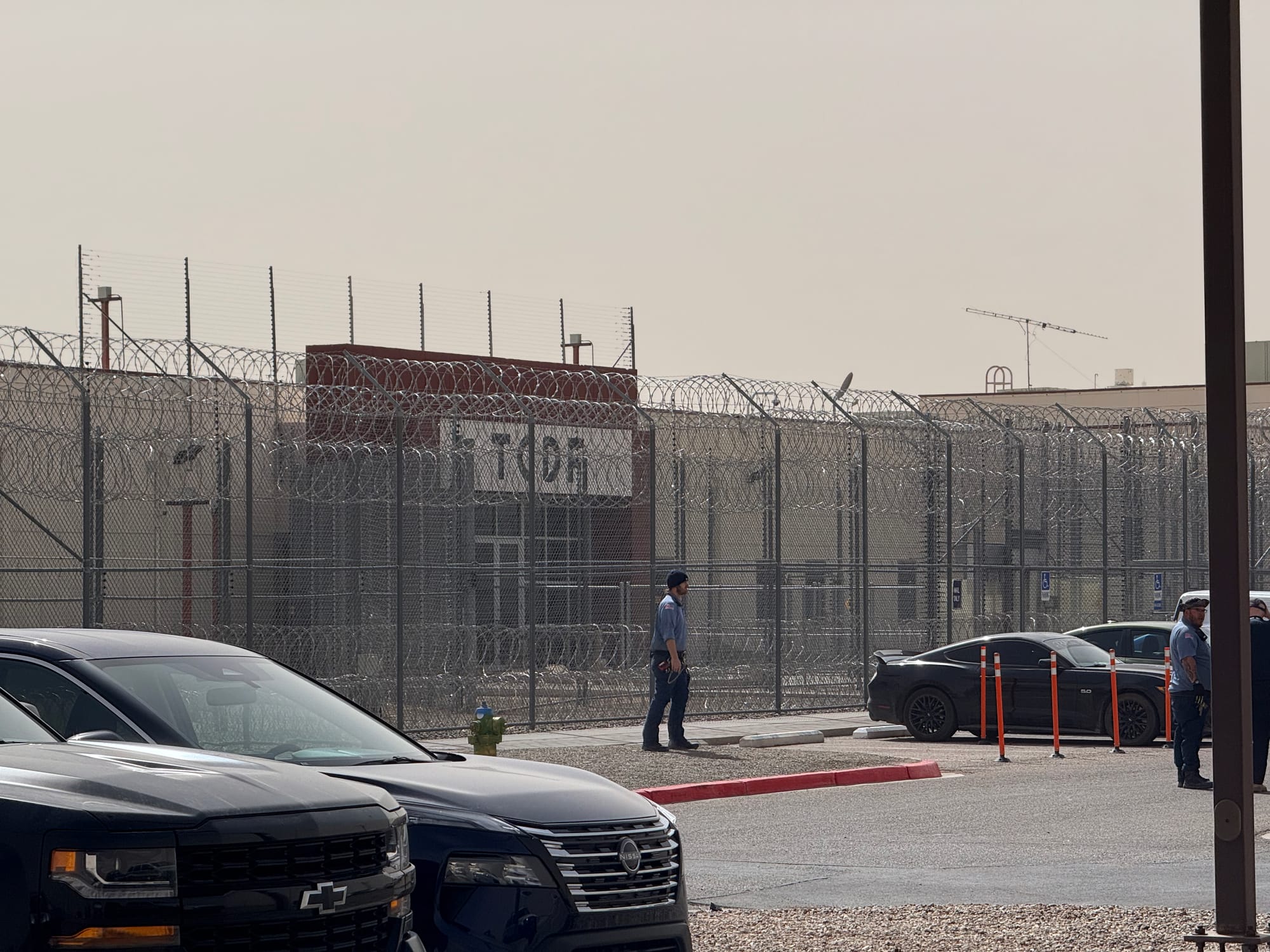
PJ Podesta, a representative of Innovation Law Lab, an organization that describes itself as "lawyers fighting for immigrant and refugee justice," appeared via Zoom during the public comment period to describe two recent incidents at the Torrance County Detention Facility, the CoreCivic-operated immigration detention center located in Estancia.
PJ Podesta told the commission that approximately two weeks prior, his legal team was denied entry to the facility. Staff from US Immigration and Customs Enforcement and CoreCivic told the team a power outage had prevented the visit. Podesta said the team later determined no power outage had occurred and that other activities — including social visits — had proceeded normally that day, leaving dozens of detained men without access to legal services.
Do ICE Detainees Have a Legal Right to Counsel in Deportation Hearings?
From a legal standpoint, detainees do not have the right to an attorney in deportation proceedings. In the well-known case of Gideon v. Wainwright, 372 US 335 (1963), Justice Hugo Black, writing for the US Supreme Court, held that individuals in state and federal criminal cases are entitled to representation. This right to counsel is not extended to detainees in immigration cases. In Immigration and Naturalization Services v. Lopez-Mendoza, 468 US 1032 (1984), Justice Sandra Day O'Connor, writing for the US Supreme Court, ruled that immigration proceedings are not considered criminal proceedings, and therefore lack the Constitutional protections that apply under the 4th Amendment (in that case it specifically dealt with the exclusion of unlawfully obtained evidence that would be barred in a criminal case under the exclusionary rule derived from the 4th Amendment).
Podesta described a second incident that occurred on April 2, 2026. Before the visit, CoreCivic staff had posted sign-up sheets in housing units, including Unit 7C, allowing detainees to register for the legal visit. Podesta alleged that a guard — whom he could not identify because staff members do not wear visible name tags — disregarded the sign-up list and brought 10 men to the visit rather than those who had signed up. When men who had registered asked to attend, Podesta said staff ordered everyone in the unit to return to their cells.
One of those men, whom Podesta identified only as Isaac, was using the toilet in his cell when a CoreCivic staff member allegedly opened the cell door and deployed pepper spray directly at his face without communicating with him first. Podesta said Isaac primarily speaks Haitian Creole (a French-based language with African influences) and some Spanish, but not English. After the spraying, Podesta said Isaac was disoriented, was taken to the ground and handcuffed, and was placed in solitary confinement, where he remained isolated as of the date of the commission meeting, despite an appeal to return to general population.
Podesta said he spoke with an assistant warden at the facility, identified as Warden Ortiz, who denied Isaac's account and declined to release him from solitary confinement.
"Isaac is a Black migrant, and this comes on the heels of numerous reports of staff's racist mistreatment of Black migrants at TCDF," Podesta told the commission.
No commissioner responded to Podesta's statement or asked questions following his remarks. Podesta called on people he described as having good consciences to organize toward closing the facility.
Commission Declines to Grant Edgewood's Request for Fire and EMS Contract
The commission heard a discussion on whether Torrance County should take over fire and emergency medical services in the Town of Edgewood, whose existing service agreement with Santa Fe County is set to expire on June 30, 2026.
County Manager J. Jordan Barela told the commission he had participated in preliminary meetings with Edgewood town management and Torrance County Fire Chief Gary Smith. He said Santa Fe County currently responds to approximately 1,200 to 1,400 calls for service annually in Edgewood, the majority of which are EMS calls. Under the current arrangement, Santa Fe County staffs three shifts — each with two advanced life support rescue units and one fire engine — totaling approximately 18 personnel at a combined annual cost of roughly $2.3 million in salaries and benefits.
Barela outlined several categories of consideration that a feasibility analysis would require: staffing levels and full-time personnel needs; apparatus, as nearly all existing equipment in Edgewood belongs to Santa Fe County and Torrance County has no surplus to deploy; communications routing, since all 911 calls from Edgewood currently flow through the Santa Fe Regional Communication Center; and facilities, as Edgewood owns a fire station currently occupied by town maintenance staff that would need to be vacated and converted.
"This is not a relatively small decision that would be made for either party," Barela said. He asked commissioners whether they wanted to direct staff to invest time in a formal feasibility analysis, framing it as the threshold question before the board.
Edgewood Town Manager Kelly Hamilton addressed the commission, thanking the board for considering the matter and requesting the opportunity to meet with the fire chief. Hamilton acknowledged the June 30 deadline for Santa Fe County coverage to end and said the town was exploring multiple options.
Commissioner Schwebach said he had no appetite to pursue the arrangement. He continued with a longer statement, saying he did not believe Torrance County could be ready to assume services by June 30 under any circumstances.
"Based on the information our - our manager has gotten, [and] our chief has gotten us, I'm going to sit here and say I don't have an appetite for it, because everybody will suffer, and where we're at here, with that being said, I understand the town does have responsibilities, and I - I'm sure you guys have a plan. You have your reasons [for ending the contract with Santa Fe County for EMS and Fire Services], and again, we're not going to get into that. So as a neighbor, we're going to facilitate where we can, but we're not going to overextend ourselves. Understand. Make that very clear, we will not overextend ourselves. We can't."
-- Torrance County Commission Chair Ryan Schwebach
Schwebach said the commission had not sought out Edgewood but did agree to discuss the matter when Edgewood approached the county, consistent with how the county handles coordination requests from other neighboring jurisdictions on EMS and fire matters.
"At this point, we are not equipped. We will not be equipped to take over services by June 30th. There is no physical way we can do it," Schwebach said.
Commissioner McCall said the county needed to address its own internal operational needs before taking on additional responsibilities. He expressed willingness to consider a mutual aid framework once Edgewood identified a primary service provider, but agreed the county was not in a position to serve as that provider.
Several members of the public offered comment during the public comment period, and in an unusual move, Schwebach briefly reopened the floor to public comment following the formal discussion.
Helena Meyer, a District 1 resident, told the commission during public comment that Torrance County fire and EMS personnel were already operating at capacity. She also raised a concern about how the request originated, saying Edgewood's deputy town manager — identified in Meyer's remarks as a former Torrance County employee — had suggested she could use personal connections with the fire chief to secure coverage. Meyer said decisions of that magnitude should not be made on the basis of personal influence.
Meyer also disputed a claim made at a Town of Edgewood special meeting the prior evening (April 7, 2026), at which Edgewood commissioners reportedly stated that the Edgewood Fire Department had previously assisted Torrance County fire operations. Meyer said the fire department operating in Edgewood is run by Santa Fe County, not the Town of Edgewood, meaning any such assistance came from Santa Fe County.
Commissioner Jaramillo praised Fire Chief Smith, saying he was doing excellent work building up Torrance County's EMS program and that she wanted him focused on the county's own needs.
No formal vote was taken. The commission reached consensus that staff would not invest further time in a feasibility analysis at this time, while leaving open the possibility of future mutual aid discussions.
FY 2025 Audit Presented; Four Units Receive Qualified Opinions
Joe Ortiz, accountant and audit partner with TKM LLC, the county's external auditors, presented the results of the Fiscal Year 2025 Comprehensive Annual Financial Audit.
The county received an unmodified opinion — the cleanest available — on its government-wide financial statements, which represent the county's full consolidated financial position. However, four of the county's individual financial reporting units received qualified opinions, meaning auditors could not express full confidence in those units' financial statements due to unresolved issues in reconciling property tax receivables, revenues, and deferred inflows of resources.
A qualified opinion — sometimes called an "except for" opinion — means auditors found the financial statements fairly presented in all material respects except for the specific identified issue. It is a less severe finding than an adverse opinion or a disclaimer of opinion, both of which indicate more fundamental problems. As discussed in the sidebar regarding audit terminology, because these four qualified opinions were delivered as multiple opinions, it may be hard to judge whether the overall financial health of Torrance County is from these individual symptoms.
Unqualified Opinion? Qualified Opinion? Disclaimer of Opinion? What do these audit-related terms mean? (Click on the toggle to learn more)
When an auditor looks at an entity during an audit, they look at what are known as the "five C's."
- Criteria - auditors look at the policies and procedures that should be used by an entity to have a healthy balance of assets and liabilities (some say the criteria is the "what should be" of an audit);
- Condition - auditors look at the evidence of financial policies and procedures and the evidence of a client's assets and liabilities to determine an overall picture of a client's financial health (the condition could be considered the client's "what is" or "financial state");
- Cause - auditors look at evidence to assess what made a client's financial health deviate from what the client's health should be (the "why it happened" that explains why a client's "financial practices" caused their condition to deviate from what should be, i.e., their criteria)
- Consequences - auditors use accounting principles to hypothesize potential outcomes of a client's conditions (the "what could happen next")
- Corrective Action - auditors use accounting principles to recommend steps a client can take to bring their condition in line with their criteria (the "how you fix things")
Many may find the language of accounting audits to not make sense because of the practice by accountants of using "terms of art" to explain their audit findings. Despite the "plain english" movement in the legal field to make lawyers' opinions sound less like, well, legalese and more like something a relatively normal human would say, accountants, particularly auditors, use terms in a way that divert dramatically from the ordinary meaning of those terms.
For example, when an auditor delivers an unqualified opinion, they are not referring to the capabilities and academic or professional qualifications of the personnel who handled the financial records. The auditor is stating that they are delivering their opinion regarding their client's financial state and their evaluation of the rules - the financial practices - used by their client's financial team to protect the client in a way that is free from doubt. An unqualified opinion is an opinion free of uncertainty, generally speaking. In academic terms, an unqualified opinion means that the auditor is not just giving the client a passing grade, the auditor is stating that the financial state and the financial practices of the client are sound.
Job well done, you get an A.
When an auditor delivers a "qualified opinion," they are stating that, based on their review of their client's financial state and financial practices, something about the client's claimed financial state or the client's financial practices is off, perhaps from what the client's practices should be or what the auditor considers a more accurate financial state. Nonetheless, what is "off" is not off so much that the client has, continuing the academic simile, failed. A qualified opinion is good enough, albeit with some serious flaws.
You get something between a B and a C, but a C is just enough to pass.
When an auditor delivers an "adverse opinion," the auditor is saying that there is something seriously wrong with the client's understanding of its financial position or the rules it follows to account for its assets and liabilities. Perhaps whatever is wrong is sufficiently wrong that there is a significant risk of fraud. Perhaps whatever is wrong indicates a substantial risk that the client is in a poor financial state, possibly even insolvent. The client does not know what it is doing and is not employing the right financial practices to know its own financial state, or worse: the client is knowingly misrepresenting its financial state or the financial practices it follows.
You get a failing grade.
When an auditor delivers a "disclaimer of opinion," that auditor is saying that based on the records made available to them by the client, or based on something that went wrong with how the client treated its assets and liabilities, the auditor knows something bad happened, but the auditor feels they lack the information to accurately say where - or why - things went wrong.
You failed. Not only did you get an F, but the teacher looked at your work and could not make enough sense of it to figure out what you were trying to do when you failed.
Confusing things, sometimes auditors may describe an adverse opinion as a disclaimer of opinion, perhaps because some auditors know something went wrong, but they do not want to risk allegations of malpractice by sticking their neck out and detailing the nature of the problem with a client's financial state or financial practices.
Torrance County's auditors have further confused things in the past by delivering audits with what they call "multiple opinions." When auditors deliver unqualified opinions, qualified opinions, adverse opinions, or disclaimers of opinions, they are following rules that are known by the acronym GAAP: Generally Accepted Accounting Principles. These are rules that govern how audits are conducted, based on the opinions of the Governmental Accounting Standards Board (or GASB). The only thing a layperson needs to know about GASB is that GASB is for auditors roughly what a bar association is for lawyers (it's not a perfect analogy).
GASB allows for entities like Torrance County to receive audit opinions that are referred to as "multiple opinions." However, GASB and auditing experts are hesitant regarding multiple opinions. Some auditors may use multiple opinions to avoid making assessments regarding the overall financial health of an entity.
Imagine a doctor telling a patient that they have an 8 millimeter mass on the frontal lobe of their brain, they have weakness on the right side of their body, and they experience grand mal seizures. For whatever reason, though, the doctor never puts together these symptoms and never says, "You have glioblastoma, a common, malignant, and deadly form of brain tumor. You can expect to live for 15 to 22 months even with treatment."
When an auditor delivers "multiple opinions" rather than one overarching opinion on the entirety of a client's financial state and practices, they risk doing what the doctor in the above analogy did. They risk identifying all the unhealthy financial "symptoms" experienced by a client, but do not put the pieces together to identify the financial cancer spreading through the client's state and practices.
Ortiz identified the source of the problem as the county treasurer's office, which was unable to provide accurate, auditable property tax schedules during the engagement. He said multiple iterations of the schedule contained errors and outdated data, ultimately preventing auditors from completing their work on those line items. He said the county faces a deadline to get that information corrected in time for the FY 2026 audit.
The county carried one finding forward from FY 2024: a $327,000 restatement to capital asset balances. Ortiz said the restatement resulted from a transition from a manual capital asset tracking method to the county's Tyler Technologies accounting system. During that transition, staff identified assets that needed to be removed from the books. Ortiz said no fraud or noncompliance was indicated and that the finding was expected to be resolved in the FY 2026 audit.
Six findings from the prior year's audit were fully resolved.
A bank reconciliation finding was also noted, though Ortiz said no misstatement had been identified. The county had reconciled the entire year's activity for one bank account in a single end-of-year reconciliation rather than on a monthly basis. Ortiz said the county had since moved to a regular monthly cadence.
Ortiz noted one new accounting standard adopted county-wide this year under GASB Statement 101, which changed how compensated absences — including sick leave — are measured and recorded. The change resulted in a modest increase in the county's compensated absences liability on the books.
The audit report was dated December 11, 2025. The New Mexico Office of the State Auditor completed its review and approved the report on March 13, 2026, at which point it became public information five days later.
Schwebach said the county appeared to be on the right trajectory. The commission voted unanimously to approve Resolution No. 2026-15, acknowledging and accepting the county's financial statements and the independent auditor's report for the year ending June 30, 2025.
Other Business
Animal Services Grant Budget Adjustment
The commission unanimously approved Resolution No. 2026-16, a budget adjustment adding $10,000 to the Animal Services Department budget. County Manager Barela said the department had received the additional funds through a grant from the Rachael Ray Foundation and that a budget adjustment was required before the department could access the money. During public comment, Animal Services employee Luke Fields described the grant's use, noting it had recently funded emergency veterinary care for a dog named Drax that was bitten by a rattlesnake. Fields also said the department had identified a contractor to proceed with $75,000 in previously approved kennel repairs, with the project now moving through procurement.
Cash Rounding Policy Deferred
Torrance County Treasurer Kathryn Hernandez presented a proposed resolution adopting a cash rounding policy, which would allow the county to round cash transactions to the nearest five cents in anticipation of the ongoing phase-out of the penny by financial institutions. Hernandez said many New Mexico counties have already adopted similar policies and that the county's bank is providing pennies only in limited quantities.
Schwebach expressed support for the concept but raised questions about how rounding would be applied consistently — whether at the invoice level or only at the point of cash receipt — and whether transactions paid by check or credit card would be treated differently. He asked that county legal counsel review the feasibility of applying rounding at the invoice stage. The commission voted to defer the resolution to the April 22 meeting.
Planning and Zoning Board Vacancies
Planning and Zoning Director Don Goen stated that the county is accepting letters of interest to fill two vacancies on the Torrance County Planning and Zoning Board, one each from District 1 and District 2. Letters must be received by the Planning and Zoning office no later than 5:00 PM on May 27, 2026. Applicants will be interviewed by the commission at its June 10 regular meeting. Eligible applicants must own or be purchasing land in Torrance County, must not be serving on another county board or commission, and must not be employed by Torrance County. Letters may be mailed to Torrance County Planning and Zoning, PO Box 48, Estancia, NM 87016, or hand-delivered to the planning and zoning office at 205 South Ninth Street, Estancia.
NMSU Cooperative Extension Program Update
Debby Maberry, Torrance County's NMSU Cooperative Extension program director, presented an overview of the office's programming. She highlighted the 4-H program's shooting sports and ceramics projects, nutrition education, school enrichment activities, and community outreach efforts. Maberry said she recently published a ceramics instruction book and expressed a goal of establishing Torrance County as a regional hub for the 4-H ceramics project. Commissioner McCall, a third-generation 4-H participant and former New Mexico 4-H state president, expressed strong support for the program and noted that the Cooperative Extension Service is funded jointly in thirds by Torrance County, New Mexico State University, and the federal government.
Domestic Violence Services — Lotus Effect Partnership
County Manager Barela presented a proposed partnership with Lotus Effect LLC, the nonprofit arm of Waves Behavioral Health, to provide wraparound domestic violence services in Torrance County. Barela explained that after the county terminated its prior memorandum of understanding with Valencia Shelter Services late last year, the county restructured its program using two local contractors funded through $60,000 in county appropriations. However, most external grant funding for domestic violence programs requires a nonprofit applicant, making the county ineligible to pursue those funds independently.
Under the proposed hybrid model, the county would retain its contractors for direct, in-county services including crisis intervention, safety planning, legal advocacy, and service coordination. Lotus Effect would provide wraparound services, including emergency shelter referrals, housing coordination, individual and group counseling, and clinical services. The nonprofit partnership would also make the county eligible to apply for additional domestic violence funding sources currently unavailable to a government organization.
Rebecca Sonnenberg, executive director of Lotus Effect, appeared via Zoom and answered questions from commissioners. Schwebach said he had reservations about nonprofit partnerships generally, citing the prior Valencia Shelter Services arrangement, in which the county terminated the contract due to inadequate service delivery while VSS continued to receive state funding through the Children, Youth and Families Department. He said he was prepared to move forward, provided any future contract included stronger performance accountability provisions. The commission reached consensus, directing staff to finalize the MOU with Lotus Effect ahead of the July 1 start of the new fiscal year. The county's legal counsel, Michael Garcia, said he had not yet reviewed the draft MOU.
Ambulance Supplemental Payment Program
Fire Chief Gary Smith presented information on the New Mexico Ambulance Supplemental Payment Program, a state initiative that allows participating fire and EMS agencies to receive supplemental Medicaid reimbursement above the standard rate. Smith said the county currently receives approximately 20 percent reimbursement on Medicaid transports. Through the program, the county could potentially recover a substantially larger share of actual transport costs through quarterly supplemental disbursements. Smith said he had been working with a Florida-based program liaison, Vanessa Miller, to understand how the program operates.
The county would need to make an upfront contribution of approximately $24,117 into a pooled fund. Smith projected that the first quarterly return — estimated for the period January 1 through March 31, 2027 — would total approximately $61,000, including return of the upfront contribution. He said 12 other New Mexico fire departments are already enrolled, including the City of Moriarty, and that all agencies he contacted reported satisfaction with the program. Commissioner McCall noted the program may involve an initial lag of approximately one year before payments begin. Smith said he would gather additional information on payment timing and that the county must submit enrollment documentation by May 31, 2026. The commission indicated general support for participation. No formal vote was taken.
Clerk's Report
County Clerk Sylvia Chavez reported that early and absentee voting for the 2026 Gubernatorial Primary will begin May 5, 2026. The primary covers races for Torrance County Sheriff, County Assessor, County Commission Districts 1 and 2, Probate Judge, Magistrate Judge, and New Mexico State House Districts 70 and 22. Chavez noted that this will be the first primary conducted under New Mexico's new open primary rules, which allow voters not registered with either major party to select either a Republican or a Democratic ballot. Registered Republicans and Democrats cannot switch their party affiliation after May 5 to vote in the opposite primary. Chavez said her office would attend election training in Albuquerque the following week and would conduct precinct worker training in late April. She also disclosed that nine of the county's vote tabulator machines had been sent out for maintenance after a Liberty Vote — also known as Dominion — technician identified faulty thermal printers during an annual maintenance visit. She said she expected the machines to be returned the following week.
Manager's Report
County Manager Barela reported that the county has completed budget hearings with all departments for the FY 2027 budget cycle. He said staff would meet with CPA Kurt Knight that week to finalize revenue forecasting and expected to schedule individual budget briefings with commissioners in the coming weeks. Barela also reported that a final site plan and floor plan for the new county administration building had been received from the project architect, and that formal commission approval of the design would be sought at the April 22 meeting. He said approval at that meeting was critical because the architects are ready to release the mechanical, electrical, plumbing, and engineering design phase, and any changes to the floor plan after that point would trigger substantial additional cost.
Commissioner McCall reported that the Torrance County Fairgrounds arena construction was progressing toward a mid-June completion target. He also noted ongoing discussions with the New Mexico Department of Transportation regarding ownership and maintenance of road approaches connecting county roads to state highways.
Commissioner Jaramillo asked the commission and audience to keep her in their thoughts, noting that her mother had recently passed away.
Next Meeting
The next regular meeting of the Torrance County Board of County Commissioners is scheduled for Wednesday, April 22, 2026, at 9:00 AM at the Torrance County Administrative Offices, 205 South Ninth Street, Estancia, New Mexico.
The Mountainair Dispatch is an independent news outlet covering Torrance County, New Mexico. Support local journalism by becoming a member or sharing this story with your neighbors.